AI Appraisal Estimate

AI-generated estimates · not official valuations

From the user

What was submitted

Photo and notes provided by the user — not generated by AI

Submitted item photo
Submitted photo · June 22, 2026

User's notes

John W Jones

AI analysis below

AI appraisal

AI analysis & estimate

AI-Generated · Verify before acting

Everything below is generated by AI for informational purposes only. AI can make mistakes — the AI may misidentify items or misattribute them (artist, maker, brand, designer, origin, era). This is not an official valuation and should not be used for insurance, sale, tax, estate, legal, or lending purposes — or any decision requiring a certified appraisal. It is not an authoritative claim about any person, brand, or rights holder — do not share or rely on it as a factual statement about a third party. Always consult qualified professionals before making financial decisions.

Note

This analysis also relies on unverified notes provided by the user, which may be incomplete or inaccurate and could affect the result.

Read the full disclaimer

AI Identification

·Not independently authenticated·Verify before acting

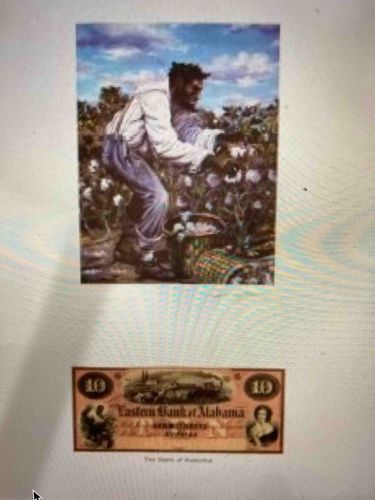
The Slave of Alabama by John W. Jones

Fine Art Prints & Historical Memorabilia

AI Estimated Value

·Not an official valuation·Verify before acting

$450 - $750

As of June 22, 2026

AI Item Analysis

·AI can make mistakes·Verify before acting
This item is an archival fine art print or lithograph by the artist John W. Jones, part of his 'Confederate Currency' series. The composition features two distinct elements on a vertical white mount or paper: a large color painting at the top and an image of historical currency at the bottom. The painting depicts an enslaved African American man harvesting cotton in a field. He is shown in a dynamic, leaning posture wearing a white long-sleeved shirt with brown suspenders and light blue trousers. The brushwork is expressive and impasto-like, utilizing a palette of earthy greens, blues, and browns against a soft blue sky. Below the artwork is a reproduction of a historical 10-dollar bill from the Eastern Bank of Alabama, which notably features a vignette of the same scene. The currency image is printed in a reddish-orange hue with black typography and decorative borders. The overall print appears to be in excellent condition with clean edges and vibrant colors. Jones is known for this specific style where he 'liberates' the figures from the small vignettes found on Confederate banknotes by enlarging them into full-scale, vivid oil paintings to highlight the obscured history of slavery during that era. The work likely dates to the late 20th or early 21st century given the artist's career timeline.
AI Appraisal Report

·AI can make mistakes·Verify before acting
I have conducted a visual examination of the archival print 'The Slave of Alabama' from John W. Jones’s 'Confederate Currency' series. The work appears to be in Tier 1 condition, exhibiting vibrant pigment density and no signs of foxing, light-bleaching, or peripheral creasing. Jones is a significant contemporary artist whose work bridges the gap between fine art and historical critique; his 'Confederate Currency' series is particularly sought after for its powerful narrative of 'liberating' figures from 19th-century banknotes. This specific piece, contrasting the $10 Eastern Bank of Alabama note with its enlarged colorized counterpart, represents a central theme in his oeuvre. The market for John W. Jones remains stable, generally appealing to collectors of African American history and Civil War memorabilia. Larger original oils from this series fetch significantly higher prices, while these signed limited-edition or open-edition archival prints trade in the mid-hundreds. Rarity is moderate, though the educational and historical value increases demand within institutional and private collections focused on social justice. Note: This appraisal is based on digital images and descriptive data. A definitive valuation is subject to physical inspection to confirm the medium (e.g., giclée vs. lithograph), verify the presence of a hand-signed signature or numbering, and inspect the paper’s watermark and acidity levels. For a full authentication, I would require a Certificate of Authenticity (COA) from the artist's studio or the representing gallery, as well as provenance documentation tracing the item’s origin.

Get your items appraised

Instant estimates of your treasures with AI-powered appraisals

Browse More Appraisals