These notes were written by the person who submitted this item. Appraiser.AI has not verified them, and the AI's identification and estimate may rely on them.
AI Estimated Value
Not an official valuation
$75-150
AI estimate as of July 25, 2025 · verify with a professional before acting
AI-Generated · Verify before acting
Everything on this page is generated by AI for informational purposes only. AI can make mistakes — the AI may misidentify items or misattribute them (artist, maker, brand, designer, origin, era). This is not an official valuation and should not be used for insurance, sale, tax, estate, legal, or lending purposes — or any decision requiring a certified appraisal. It is not an authoritative claim about any person, brand, or rights holder — do not share or rely on it as a factual statement about a third party. Always consult qualified professionals before making financial decisions.
This analysis also relies on unverified notes provided by the user, which may be incomplete or inaccurate and could affect the result.
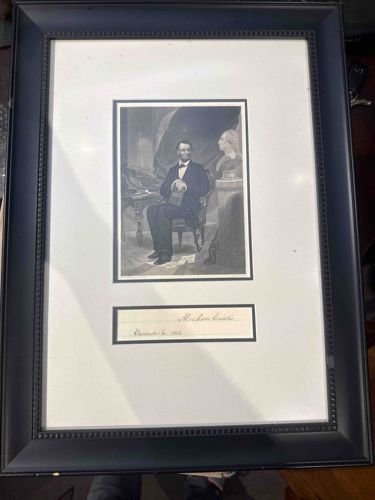
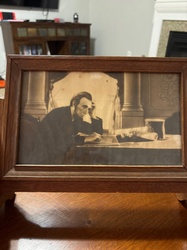
This item is a framed print and facsimile signature of Abraham Lincoln. The primary image is a black and white or grayscale print depicting Abraham Lincoln seated, holding a book, with a classical bust visible to his right. He appears to be in a study or office setting, with drapes and a table visible in the background. The print itself is rectangular, oriented vertically, and is matted within a larger white matboard. Below the main print, there is a smaller, separate rectangular opening in the matboard which contains a facsimile of what appears to be a signature of 'Abraham Lincoln' and a date, possibly 'December 18, 1903' or similar. The overall piece is housed in a substantial, dark-colored, likely black, wooden frame with a decorative textured or beaded inner rim. The frame shows some minor dust accumulation and possibly minimal wear on its surfaces. The matboard appears to be clean with no obvious staining, although there might be very faint discolored spots, possibly dust or age-related subtle toning, particularly in the upper right quadrant of the mat. The glass covering the print and signature is clear, though it reflects some environmental light in the image, suggesting its presence and condition. The quality of the print appears good, with clear details and shading, characteristic of a photomechanical reproduction rather than an original drawing or painting. The arrangement suggests an aesthetic presentation, likely for display in a home or office.
AI Appraisal Report
I have carefully examined the provided image of the framed Abraham Lincoln print with a facsimile signature. Visually, the print itself appears to be a good quality photomechanical reproduction, not an original drawing or painting, which is typical for such memorabilia. The framing is substantial, a dark-colored wooden frame with a decorative inner rim, and the matting is clean, though I observe very faint, subtle toning or dust accumulation, particularly in the upper right quadrant of the mat, consistent with age and display. The glass is clear, showing reflections, indicating its presence and condition. The 'signature' section is clearly a facsimile, likely a photographic reproduction of an original signature or a pre-printed inscription, as indicated by the owner's note 'facsimile signature.' This means the signature is not an original, hand-inked autograph by Abraham Lincoln, but a reproduction. Its value is therefore as a decorative historical print, not as an autographed document. The date 'December 18, 1903' below the facsimile signature, if accurately read, is significantly after Lincoln's death (1865), reinforcing that the signature element is a reproduction and not an original. The market for historical prints, particularly of prominent figures like Abraham Lincoln, is consistent. Prints of this nature, especially those with decorative facsimiles of signatures, generally appeal to a broad audience interested in American history and decorative arts. They are not rare as original signed documents, but the overall presentation is appealing. Comparables for framed decorative prints of historical figures, especially Lincoln, without original autographs, typically range based on size, frame quality, and overall aesthetic appeal. For full authentication, a physical examination would be crucial to assess the print's exact reproductive process (e.g., photogravure, lithograph, halftone) and the material quality of the paper and framing components. Provenance documentation, while not usually available for prints of this kind, would be vital for any claim of originality beyond the clearly visible facsimile. Scientific testing is not applicable here as the item is clearly a print and a facsimile. The primary limitation to valuation is the clear understanding that the signature is a reproduction and not an original. Without that clarity, the item could be misrepresented, significantly altering its perceived value.