AI estimate as of August 31, 2025 · verify with a professional before acting
AI-Generated · Verify before acting
Everything on this page is generated by AI for informational purposes only. AI can make mistakes — the AI may misidentify items or misattribute them (artist, maker, brand, designer, origin, era). This is not an official valuation and should not be used for insurance, sale, tax, estate, legal, or lending purposes — or any decision requiring a certified appraisal. It is not an authoritative claim about any person, brand, or rights holder — do not share or rely on it as a factual statement about a third party. Always consult qualified professionals before making financial decisions.
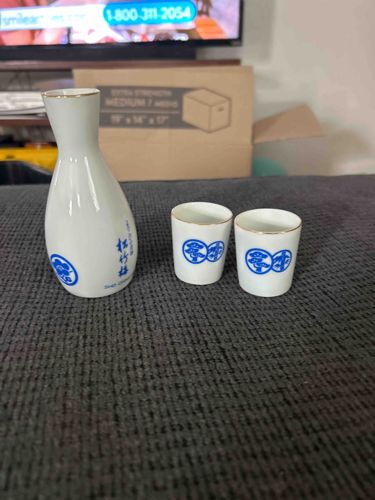
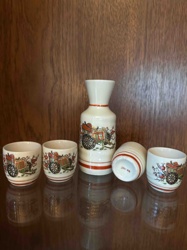
This item is a sake set, featuring one tokkuri (sake flask) and two ochoko (sake cups), all made of white ceramic. The tokkuri has a classic pear-shaped body with a narrow neck and a flared spout. Both the tokkuri and the ochoko are adorned with a blue transferware design and gold trim along their rims. The blue design on the tokkuri includes what appears to be Japanese characters vertically arranged on one side and a circular crest or emblem on another. The ochoko cups feature a similar circular blue emblem, possibly an abstract or stylized symbol, which is repeated in a pattern. The gold trim shows some minor wear, which is typical for items of this nature that have been handled or used. The ceramic appears to be glazed, giving it a smooth, glossy finish. There are no obvious chips, cracks, or significant repair marks visible in the image, suggesting the set is in good overall condition. The design suggests a traditional Japanese aesthetic, likely produced in the mid to late 20th century. The quality of craftsmanship appears to be commercial grade, suitable for everyday use rather than high-end decorative display, indicated by the uniformity of the shapes and the clear transferware application. The characters observed on the tokkuri could potentially indicate a brand name or type of sake.
AI Appraisal Report
Upon my virtual examination of the provided image of this ceramic sake set, I assess its condition as good. There are no apparent chips, cracks, or significant repairs visible, which is positive. The gold trim shows minor wear, consistent with typical handling, but this does not detract significantly from its aesthetic appeal or function. The uniformity of shape and crispness of the blue transferware application suggest commercial-grade production, likely mid to late 20th century, rather than artisanal craftsmanship.
From a market perspective, comparable mid-century transferware sake sets of similar commercial quality typically fetch modest prices. There is a consistent, albeit not high, demand for such functional and decorative Japanese tableware. This set is not particularly rare; mass-produced items generally are not. Factors impacting value positively include its complete nature (tokkuri and two ochoko) and good condition. Negatively, its commonality and commercial production limit its upper value. The aesthetic appeal is pleasant, but the lack of unique artistry or historical significance prevents it from entering a higher price bracket.
Authenticity, in terms of its Japanese origin and age, is generally supported by the design cues. However, definitive verification of age, specific ceramic type, or precise origin (e.g., specific kiln or manufacturer) cannot be determined from images alone. An in-person examination would allow for tactile assessment of the ceramic, closer inspection of the glaze and gold trim for nuances of age, and clearer identification of any maker's marks or impressed characters. Provenance documentation, if available, would further solidify its history. Scientific testing, while possible, would typically be overkill for an item in this price range.