AI estimate as of August 31, 2025 · verify with a professional before acting
AI-Generated · Verify before acting
Everything on this page is generated by AI for informational purposes only. AI can make mistakes — the AI may misidentify items or misattribute them (artist, maker, brand, designer, origin, era). This is not an official valuation and should not be used for insurance, sale, tax, estate, legal, or lending purposes — or any decision requiring a certified appraisal. It is not an authoritative claim about any person, brand, or rights holder — do not share or rely on it as a factual statement about a third party. Always consult qualified professionals before making financial decisions.
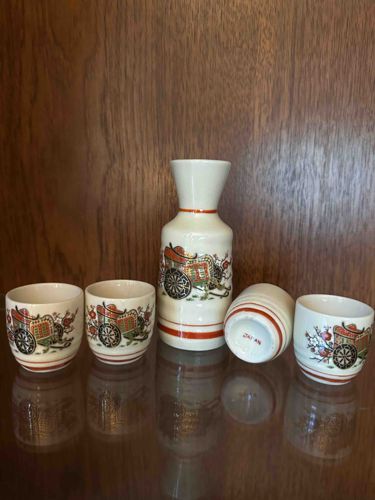
This is a five-piece Japanese sake/rice wine set, consisting of one tall serving carafe (tokkuri) and four small drinking cups (guinomi or ochoko). Each piece is crafted from glazed ceramic, likely porcelain, in an off-white or cream base color. The decoration features a detailed, colorful motif of an ornate, traditional Japanese wheeled cart (possibly an oxcart or a flower cart), surrounded by delicate floral elements and foliage. The primary colors in the decoration are reds/oranges, greens, blues, and black, outlined in dark brown or black. The cart design appears consistent across all pieces, though the exact positioning and floral accents may vary slightly. Both the carafe and the cups have horizontally applied orange/red bands, typically two thin bands near the base and one or two similar bands near the rim. The carafe has a narrow neck and a flared rim. One of the drinking cups is shown on its side, revealing a red 'JAPAN' mark stamped on its unglazed foot, indicating its country of origin. The glaze appears to be intact with a subtle sheen, suggesting good overall condition with no obvious chips, cracks, or significant wear visible from the photograph. The craftsmanship appears to be of good quality, with consistent painting and glazing. Based on the 'JAPAN' mark and typical styling, this set likely dates from the mid-20th century, possibly post-WWII.
AI Appraisal Report
I have examined the provided image of this five-piece Japanese ceramic sake set featuring an ox cart motif. Based on visual assessment, the condition appears to be very good; the glaze is intact with a subtle sheen, and there are no visible chips, cracks, or significant wear. The consistent painting and glazing suggest good craftsmanship.
Authenticator by the red 'JAPAN' mark on the foot of one cup, this set is undeniably of Japanese origin. This mark, combined with the stylistic elements, supports a mid-20th century dating, likely post-WWII when such marks became common for export wares.
Regarding market conditions, sets of this nature are relatively common in the secondary market. While the ox cart motif is pleasing and well-executed, it does not suggest a specific renowned kiln or artist that would confer significant rarity. Demand for vintage Japanese sake sets exists, but it is typically moderate, driven by collectors of Japanese ceramics or individuals seeking decorative barware. Comparables for similar mid-century export sake sets in very good condition typically range from $60 to $150, depending on the intricacy of the design and overall condition.
The main factors impacting value are the completeness of the set, its excellent condition, and the attractive, well-preserved decoration. There are no significant negative factors.
Limitations in authenticity verification from images alone exist. A physical examination would allow me to inspect for hairline cracks, subtle glaze imperfections, or repairs not visible in the photograph. I would also check the weight and feel of the ceramics, and explore the possibility of any impressed marks or finer details not captured. Provenance documentation, such as original sales receipts or gift records, would further solidify its history, though for common export wares, this is less critical than for historical or artist-signed pieces. Scientific testing is generally not required for basic authentication of this type of item.