AI estimate as of November 5, 2025 · verify with a professional before acting
AI-Generated · Verify before acting
Everything on this page is generated by AI for informational purposes only. AI can make mistakes — the AI may misidentify items or misattribute them (artist, maker, brand, designer, origin, era). This is not an official valuation and should not be used for insurance, sale, tax, estate, legal, or lending purposes — or any decision requiring a certified appraisal. It is not an authoritative claim about any person, brand, or rights holder — do not share or rely on it as a factual statement about a third party. Always consult qualified professionals before making financial decisions.
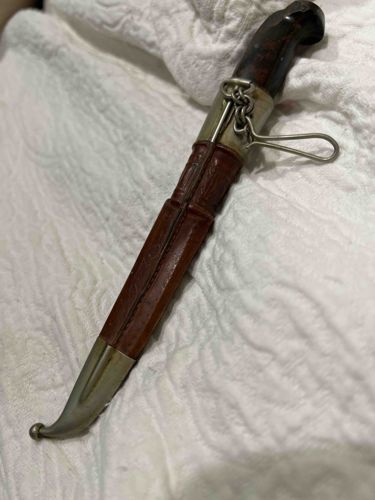
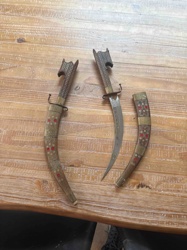
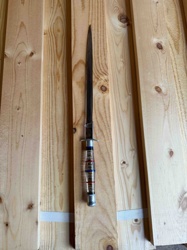
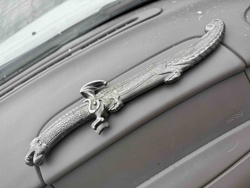
This is an antique Khanjar, a traditional Omani dagger, characterized by its distinctive curved blade and ornate sheath. The handle appears to be crafted from a dark, possibly hardwood or horn, showing a rich, deep brown to black color with natural grain or texture visible. It has an ergonomic, slightly bulbous shape designed for a secure grip. Immediately below the handle is a metallic collar or bolster, likely silver-toned metal, which transitions into the scabbard. Attached to this bolster is a chain and a prominent loop or hook mechanism, also made of silver-toned metal, presumably for attaching the dagger to a belt or sash.
The scabbard itself is made of dark brown leather, exhibiting signs of age and wear such as minor scratches, discoloration, and softening, consistent with its likely vintage. The leather appears to be structured, possibly featuring internal stiffeners or a wooden core, and is possibly stitched, though the exact construction details are obscured. The tip of the scabbard is encased in a decorative metal chape, matching the silver-toned metal of the hilt fittings. This chape has a pronounced upward curve, typical of Khanjars, and terminates in a small, spherical finial. The overall condition suggests a well-used but cared-for item, with visible patina on both the metal and leather components, indicating its age rather than significant damage. The craftsmanship, particularly the fitted metalwork and shaped handle, points to a period of traditional artisan production. The lack of visible maker's marks or signatures prevents definitive manufacturing attribution, but its unique style strongly suggests an Omani origin and a mid-20th century or earlier estimated age. The intricate details of the metal chain and hook further enhance its unique character.
AI Appraisal Report
Upon examining the provided image of this Antique Khanjar with Leather Scabbard, I've assessed its condition and authenticity to the best of my ability from a visual perspective. The item presents as a genuine traditional Omani Khanjar, consistent with what one would expect from a mid-20th century or earlier piece. The dark, possibly horn or hardwood handle exhibits appropriate aging and a pleasing ergonomic form. The silver-toned metal fittings, including the bolster, chain, hook mechanism, and the distinctive upturned chape, show a desirable patina indicative of age rather than neglect. The dark brown leather scabbard displays expected wear, minor scratches, and discoloration, which contribute to its authenticity and history rather than detracting significantly from its value. This 'well-used but cared-for' appearance enhances its character as a collectible.
Factors impacting value include its overall good condition for its age, the intact metalwork, and the characteristic Omani design. Market conditions for antique Omani Khanjars are generally stable, with demand often driven by collectors of ethnographic weapons and Middle Eastern artifacts. While not exceptionally rare, well-preserved examples like this one are consistently sought after. Comparable sales for similar mid-range antique Khanjars with traditional materials and good condition typically fall within the $400-$700 bracket. Higher values are usually reserved for pieces with extensive silver filigree, precious stone embellishments, or confirmed provenance to a specific region or artisan.
It is crucial to note the limitations of image-based appraisal. For full authentication, an in-person examination would be required to verify the material composition of the handle (e.g., horn versus specific hardwood), confirm the silver content of the metal fittings (e.g., sterling silver vs. silver-plated base metal), and assess the construction integrity of the scabbard. Furthermore, any provenance documentation, such as family history or previous ownership records, would significantly enhance its value by providing a richer narrative and confirming its historical journey. Without these, the appraisal remains based on visual cues and market trends for similar undocumented pieces.