Pair of Moroccan Koummya Daggers
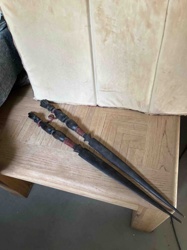
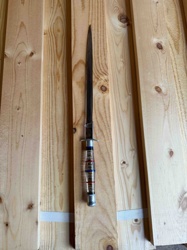
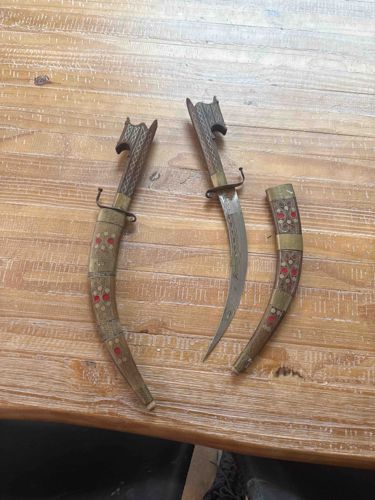
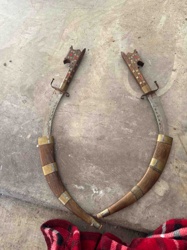
This is a pair of North African Moroccan daggers known as koummya, a traditional variation of the Arabic jambiya. Each piece features a characteristic curved, single-edged blade that tapers to a sharp point, often associated with Berber craftsmanship. The hilts exhibit a distinctive 'peacock' or arched pommel shape, common in the 20th century. The handles appear to be constructed from a combination of wood and metal, featuring geometric incised lines and wire wrapping. The metal scabbards are notably ornate, decorated with brass or silver-toned metal overlays and inset with red and white circular decorative elements, likely lacquer or glass beads, arranged in floral or geometric patterns. These items show visible signs of mid-20th-century craftsmanship typical of the tourist or ceremonial trade. Condition-wise, there is evident oxidation on the steel blades and a heavy patina with darkening on the metal scabbards. One dagger remains in its scabbard, while the other is shown unsheathed, revealing full blade curvature. Minor wear is present on the decorative insets and metal joints, indicating age but maintaining overall structural integrity.
AI-Generated Appraisal Disclaimer
Estimated Value
$150-$250
Basic Information
Category
Antique Weaponry / North African Militaria
Appraised On
January 10, 2026
Estimated Value
$150-$250
Item Description
This is a pair of North African Moroccan daggers known as koummya, a traditional variation of the Arabic jambiya. Each piece features a characteristic curved, single-edged blade that tapers to a sharp point, often associated with Berber craftsmanship. The hilts exhibit a distinctive 'peacock' or arched pommel shape, common in the 20th century. The handles appear to be constructed from a combination of wood and metal, featuring geometric incised lines and wire wrapping. The metal scabbards are notably ornate, decorated with brass or silver-toned metal overlays and inset with red and white circular decorative elements, likely lacquer or glass beads, arranged in floral or geometric patterns. These items show visible signs of mid-20th-century craftsmanship typical of the tourist or ceremonial trade. Condition-wise, there is evident oxidation on the steel blades and a heavy patina with darkening on the metal scabbards. One dagger remains in its scabbard, while the other is shown unsheathed, revealing full blade curvature. Minor wear is present on the decorative insets and metal joints, indicating age but maintaining overall structural integrity.
Get Your Items Appraised
Instant estimates of your treasures with AI-powered instant appraisals