AI estimate as of September 20, 2025 · verify with a professional before acting
AI-Generated · Verify before acting
Everything on this page is generated by AI for informational purposes only. AI can make mistakes — the AI may misidentify items or misattribute them (artist, maker, brand, designer, origin, era). This is not an official valuation and should not be used for insurance, sale, tax, estate, legal, or lending purposes — or any decision requiring a certified appraisal. It is not an authoritative claim about any person, brand, or rights holder — do not share or rely on it as a factual statement about a third party. Always consult qualified professionals before making financial decisions.
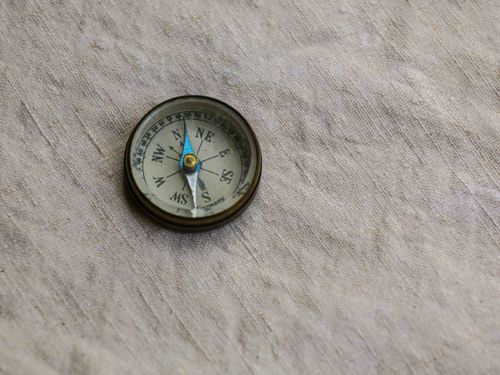
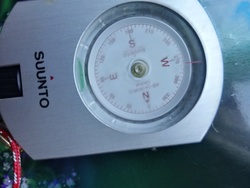
This item is a vintage pocket compass, notable for its classic design and apparent age. Physically, it is a small, circular instrument, likely measuring approximately 4-5 cm in diameter based on its presentation against the fabric background. The casing appears to be made of brass or a similar copper alloy, exhibiting a darkened patina which suggests significant age and exposure, indicative of its vintage status. The color of the casing is a muted, aged brass, hinting at oxidation over time rather than a polished, new appearance. The compass features a clear glass or perhaps plastic cover, which has some visible scuffing or dust accumulation, but generally allows a clear view of the compass dial. The dial itself is a light, possibly off-white or cream color, with black markings for the cardinal (N, S, E, W) and intercardinal (NE, SE, SW, NW) directions, along with degree markings to guide navigation. The magnetic needle is prominently displayed, with one half painted a distinct light blue, likely indicating North, and the other half a darker, possibly silver or black tone. A small, golden pivot point secures the needle in the center. The craftsmanship appears to be functional and straightforward, typical of navigational tools from the late 19th to mid-20th century. There are no obvious signs of significant damage like cracks in the glass or major dents in the casing, though the overall aged appearance and minor surface wear suggest frequent use or less-than-pristine storage. A small, faint inscription or logo, possibly 'FRANCE' or a similar short word, can be vaguely discerned near the 'S' marking on the dial, which could be a manufacturer's mark indicating its origin or brand. This type of compass would have been a personal navigation tool, often carried in a pocket, reflecting a style period ranging from the late Victorian to early mid-century.
AI Appraisal Report
I have examined the provided image of this vintage pocket compass. Based on its appearance, I assess its condition as 'good-fair vintage' due to the consistent patina, minor scuffing on the cover, and general signs of age and use. The casing’s brass or copper alloy and the dial’s design align with typical navigational tools from the late 19th to mid-20th century. The magnetic needle appears intact and functional, with clear directional markings. The faint inscription near the 'S' is intriguing; if it indeed reads 'FRANCE' or a known manufacturer, it could offer a slight boost to provenance, but this is uncertain from the image alone.
Authenticity, based purely on visual inspection, seems plausible as a period piece, though precise dating without more specific manufacturer marks is difficult. The market for vintage pocket compasses, while steady, is not exceptionally high unless the item boasts significant rarity, historical provenance, or a prominent maker. Comparables typically fall within the $30-$100 range for functional, uncleaned examples. This compass falls into the more common utilitarian category rather than a high-end collectible.
Factors impacting value include its good overall preservation despite wear, and the apparent functionality of the needle. However, the lack of a prominent, identifiable manufacturer, significant historical association, or unique design limits its upper value. Without physical inspection, I cannot confirm the integrity of the needle pivot, the material of the cover (glass vs. plastic), or the authenticity of any faint markings. A hands-on examination would allow for definitive identification of materials, assessment of mechanical function, and closer inspection of any maker's marks or serial numbers for full authentication.