AI estimate as of September 20, 2025 · verify with a professional before acting
AI-Generated · Verify before acting
Everything on this page is generated by AI for informational purposes only. AI can make mistakes — the AI may misidentify items or misattribute them (artist, maker, brand, designer, origin, era). This is not an official valuation and should not be used for insurance, sale, tax, estate, legal, or lending purposes — or any decision requiring a certified appraisal. It is not an authoritative claim about any person, brand, or rights holder — do not share or rely on it as a factual statement about a third party. Always consult qualified professionals before making financial decisions.
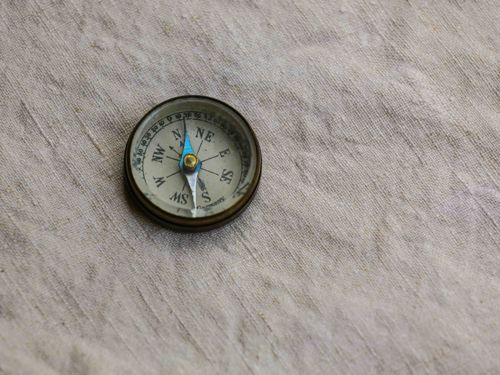
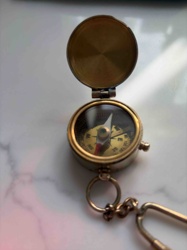
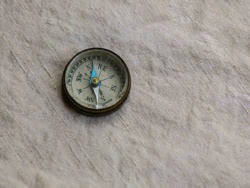
This item is a vintage-style pocket compass, characterized by its classic circular form and relatively small size, suggesting portability. The compass is encased in what appears to be a metal, likely brass or a brass alloy, which exhibits a visible patina and some discoloration, indicative of age and handling. This green-brown tarnishing is particularly noticeable around the edges of the casing and beneath the glass, adding to its antique aesthetic. The face of the compass is white or off-white, displaying standard cardinal directions (N, S, E, W) and intercardinal directions (NE, SE, SW, NW) in black lettering. Incremental markings for intermediate degrees are also present. The magnetic needle has a distinct blue half and a silver/gray half, both tapering to a point, with the blue end presumably indicating North. The needle pivots on a central pin which appears to be yellow or brass-colored. A clear glass or plastic cover protects the compass face, through which a few specks of dust or debris are visible on the dial, suggesting some wear or lack of a perfectly sealed environment over time. The craftsmanship appears functional, with clear legibility of the cardinal points. There is a small, illegible inscription or mark located near the 'S' of the southwest marking ('SW'), possibly a manufacturer's initial or a decorative element. The overall condition suggests a used but well-preserved item, possibly from the early to mid-20th century, given its design and apparent material aging. It presents as a simple, unadorned navigational tool.
AI Appraisal Report
Upon visual examination of this vintage-style pocket compass, I assess its condition as good, consistent with age and use. The metal casing, likely brass, displays an attractive patination and some discoloration, which is indicative of its vintage nature and handling. The legible dial with clear cardinal and intercardinal directions, coupled with the distinct magnetic needle, confirms its functional design. Minor dust or debris beneath the glass cover suggests typical wear but does not significantly detract from its aesthetic or likely functionality. Authenticity appears consistent with a navigational tool from the early to mid-20th century, given the material aging and design cues. However, without physical examination, I cannot definitively confirm the precise alloy of the casing or confirm that it is not a modern reproduction mimicking an antique.
Market conditions for such vintage pocket compasses are generally stable. Comparables typically range from $30 to $100 depending on specific provenance, maker, and condition. This particular compass, being a simple, unadorned model without a renowned maker's mark (the small inscription being illegible), falls into the lower to mid-range of this spectrum. Demand is moderate, primarily from collectors of vintage scientific instruments, outdoor enthusiasts, or those seeking decorative items. Rarity is not a significant factor here; similar items are relatively common. Factors impacting its value negatively are the lack of a clear manufacturer's mark and any unique historical significance. For full authentication and to ascertain the exact material composition, an in-person examination, including potential metallurgical testing, and any available provenance documentation would be essential. It is also difficult to test its functional accuracy without a physical inspection.