AI Appraisal Estimate

AI-generated estimates · not official valuations

From the user

What was submitted

Photo and notes provided by the user — not generated by AI

Submitted item photo
Submitted photo · June 13, 2026

User's notes

No additional notes provided.

AI analysis below

AI appraisal

AI analysis & estimate

AI-Generated · Verify before acting

Everything below is generated by AI for informational purposes only. AI can make mistakes — the AI may misidentify items or misattribute them (artist, maker, brand, designer, origin, era). This is not an official valuation and should not be used for insurance, sale, tax, estate, legal, or lending purposes — or any decision requiring a certified appraisal. It is not an authoritative claim about any person, brand, or rights holder — do not share or rely on it as a factual statement about a third party. Always consult qualified professionals before making financial decisions.

Read the full disclaimer

AI Identification

·Not independently authenticated·Verify before acting

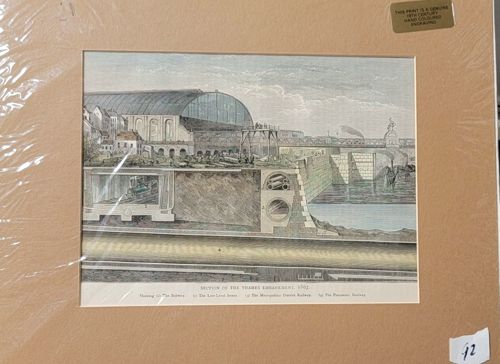
Section of the Thames Embankment, 1867: Hand-Coloured Engraving

Antique Prints and Map Art

AI Estimated Value

·Not an official valuation·Verify before acting

$150 - $250

As of June 13, 2026

AI Item Analysis

·AI can make mistakes·Verify before acting
This item is a 19th-century hand-coloured steel or wood engraving depicting a detailed architectural and engineering cross-section of the Thames Embankment in London, dated 1867. The print utilizes fine-line engraving techniques to show the multi-layered infrastructure project, including the Metropolitan District Railway, low-level sewers, and the subway systems beneath the riverside walkway and Charing Cross Railway Bridge. The scene features a delicate palette of hand-applied watercolours, with soft greens, blues, and earth tones highlighting the various structural components and the surrounding urban environment. The engraving is presented in a tan-coloured window mount (matting) and appears to be protected by a plastic film or shrink-wrap. A gold foil sticker in the top right corner identifies it as a 'Genuine 19th Century Hand Coloured Engraving.' Notably, the bottom of the print includes a comprehensive legend or key identifying specific elements such as 'The Subway,' 'The Low-Level Sewer,' and 'The Metropolitan District Railway.' The condition appears generally good, though there is a small visible dark spot near the center-bottom of the image area which could be a foxing mark or a minor blemish on the paper. The print showcases high-quality Victorian technical draughtsmanship and topographical artistry, typical of mid-to-late 19th-century educational or periodical publications like 'The Illustrated London News.'

AI Appraisal Report

·AI can make mistakes·Verify before acting
I have completed a visual examination of this mid-Victorian hand-coloured engraving depicting the infrastructure of the Thames Embankment (c. 1867). Authenticity is indicated by the fine-line steel engraving technique and the presence of contemporary hand-applied watercolour washes. The typography and detailed architectural legend are consistent with high-end Victorian periodicals such as 'The Illustrated London News' or specialized engineering supplements from the late 1860s. The condition appears generally good, though I have noted a distinct dark spot near the lower-center margin likely caused by localized foxing or a paper blemish. The tan window mount and gold foil sticker suggest it was marketed by a commercial print dealer in the late 20th century. Market demand for 19th-century technical and industrial prints remains steady, particularly among collectors of London topography and civil engineering history. While mass-produced for the public at the time, well-preserved sections of this specific project are becoming increasingly desirable for interior decor. Limitations to this appraisal: A visual assessment of a digital image cannot confirm the paper’s weight, watermark, or whether the colouring is strictly contemporary to the print or added later. For a definitive authentication, I would require an in-person physical inspection out of the frame to check for paper acidity and reverse-side markings. Scientific testing of the pigment binders or paper fibers would only be necessary if an original artist’s proof was suspected; however, for a standard periodical engraving, provenance documentation from the original publication source would suffice. The current valuation reflects its status as a high-quality decorative antique rather than a museum-grade rarity.

Get your items appraised

Instant estimates of your treasures with AI-powered appraisals

Browse More Appraisals