These notes were written by the person who submitted this item. Appraiser.AI has not verified them, and the AI's identification and estimate may rely on them.
AI Estimated Value
Not an official valuation
$60-90
AI estimate as of November 23, 2025 · verify with a professional before acting
AI-Generated · Verify before acting
Everything on this page is generated by AI for informational purposes only. AI can make mistakes — the AI may misidentify items or misattribute them (artist, maker, brand, designer, origin, era). This is not an official valuation and should not be used for insurance, sale, tax, estate, legal, or lending purposes — or any decision requiring a certified appraisal. It is not an authoritative claim about any person, brand, or rights holder — do not share or rely on it as a factual statement about a third party. Always consult qualified professionals before making financial decisions.
This analysis also relies on unverified notes provided by the user, which may be incomplete or inaccurate and could affect the result.
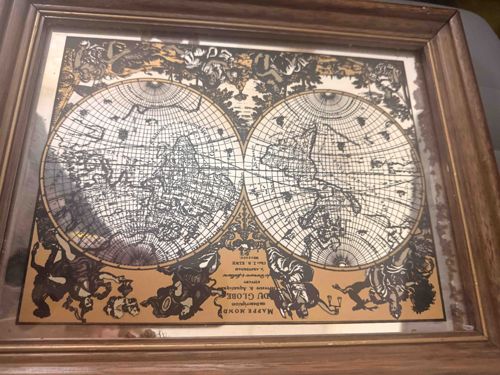
This item is a framed reproduction of an antique world map, likely a decorative piece. The map itself depicts the world in two hemispherical projections, common in cartography from the 16th to 18th centuries. The coloration of the map is primarily black and white on a warm, earthy tone background, possibly sepia or light brown, which mimics aged paper. Surrounding the cartographic depictions are intricate decorative borders featuring mythological figures, flora, and fauna, rendered in a style consistent with period engravings. There are visible cartouches and textual elements below the map, though their specific content is difficult to discern due to the image resolution and angle, but they appear to be titles or legends, potentially in French, given phrases like "MAPPE MOND" and "DU GLOBE." The map is enclosed within a sturdy wooden frame with a medium-brown finish, exhibiting a visible wood grain and some subtle variations in color, suggesting a natural wood or a well-simulated wood veneer. The frame has a classic, slightly ornate profile with a beveled inner edge. The item appears to be under glass or a clear acrylic panel, which causes reflections, particularly in the lower left quadrant of the map and along the frame, indicating its protective covering. The visible condition suggests some minor wear on the frame, consistent with age or handling, but the map print itself appears to be in good condition, with no overt tears, fading, or significant damage. The overall aesthetic points to a decorative item designed to evoke a sense of historical elegance, likely produced as a retail-market reproduction rather than an original antique.
AI Appraisal Report
Upon examination of the provided image, this item is identified as a framed decorative reproduction of an antique world map. The map style, featuring hemispherical projections and ornate borders, is characteristic of 16th to 18th-century cartography, but the overall presentation points to a modern decorative piece. The wooden frame is a standard, mass-produced type, and the print itself, while aesthetically pleasing, appears to be a common retail reproduction designed to mimic aged paper. A crucial detail provided by the owner, that the map is 'mirrored,' confirms it is a decorative reproduction, as this is a common printing error in non-authentic pieces and renders it cartographically useless.
The condition of the item appears good, with minor wear on the frame consistent with normal household use. As a decorative wall hanging, its value is tied to its aesthetic appeal rather than any historical or cartographic significance. The market for such reproductions is broad and saturated, with many similar items available in home decor stores and online marketplaces. Comparables for framed, decorative map prints of this size and style typically sell in the secondary market for between $50 and $100. There is no rarity associated with this piece.
This appraisal is based solely on the visual information provided. Definitive authentication was not possible; however, based on the evidence, this is not an original antique map. An in-person examination could confirm the printing method (e.g., offset lithography) and materials, but it would not significantly alter the valuation, which is based on its identity as a decorative, mass-market item.