These notes were written by the person who submitted this item. Appraiser.AI has not verified them, and the AI's identification and estimate may rely on them.
AI Estimated Value
Not an official valuation
$3,000 - 5,000
AI estimate as of September 27, 2025 · verify with a professional before acting
AI-Generated · Verify before acting
Everything on this page is generated by AI for informational purposes only. AI can make mistakes — the AI may misidentify items or misattribute them (artist, maker, brand, designer, origin, era). This is not an official valuation and should not be used for insurance, sale, tax, estate, legal, or lending purposes — or any decision requiring a certified appraisal. It is not an authoritative claim about any person, brand, or rights holder — do not share or rely on it as a factual statement about a third party. Always consult qualified professionals before making financial decisions.
This analysis also relies on unverified notes provided by the user, which may be incomplete or inaccurate and could affect the result.
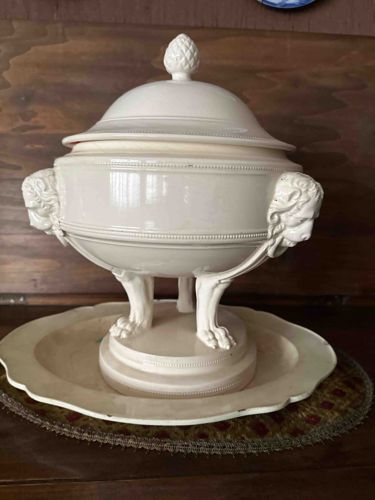
This is a substantial neo-classical creamware tureen, complete with its original undertray, presenting a striking aesthetic in an off-white or ecru glazed ceramic. The tureen features a robust, rounded body with prominent decorative elements. On either side, highly detailed lion’s head masks serve as handles or decorative motifs, showcasing finely sculpted facial features and manes. The body of the tureen is encircled by two raised, beaded bands, one near the rim and another below the lion head applications, adding textural interest. The domed lid is topped with a finely modeled pineapple finial, a classic symbol of hospitality, also adorned with textured details. The tureen stands on four stout, animalistic paw feet, possibly lion paws given the lion head motifs, which are integrated into a circular, stepped base with a beaded band. These feet transition smoothly from the tureen's body, providing stability and visual balance. The accompanying undertray is scalloped or fluted around its edge, echoing the rounded forms of the tureen, and features a slightly raised center to securely accommodate the tureen's base. The overall glaze appears consistent and even, with a subtle sheen, suggesting a high-quality firing. There are no immediately obvious chips, cracks, or repairs visible, suggesting generally good condition. The style points to a late 18th to early 19th-century period, indicative of the Giustiniani manufactory known for its reproduction of classical forms, hence the specific naming suggestion in the context. The craftsmanship is evident in the detailed molding and coherent design, typical of a well-executed ceramic piece of its era.
AI Appraisal Report
Based on my examination of the image and the provided details, this Giustiniani Neo-Classical Creamware Tureen with Undertray presents as a remarkably well-preserved example from the late 18th to early 19th century. The detailed description highlights the exceptional craftsmanship, including the lion's head masks, beaded bands, pineapple finial, and paw feet, all indicative of high-quality molding and design typical of the Giustiniani manufactory. The stated 'off-white or ecru glazed ceramic' and 'consistent and even glaze' suggest good original condition, with no immediately obvious chips, cracks, or repairs, which significantly bolsters its value.
Market conditions for early neoclassical creamware, especially pieces attributed to renowned makers like Giustiniani, remain robust among collectors of 18th-century decorative arts. The completeness with its original undertray is a substantial factor, as such sets are far rarer and more desirable than individual pieces. Demand for well-executed historical ceramics with classical motifs is steady, particularly for items that present as decorative and functional art. The detailed relief work and thematic consistency make this piece highly attractive.
Factors impacting value positively include its apparent excellent condition and the coherence of the set. Rarity is high due to age, material (creamware), and the specific manufacturer.
**Limitation for Authenticity Verification:** While the description strongly aligns with known Giustiniani production, a definitive authentication would require in-person examination. I would need to inspect for maker's marks, glaze characteristics under magnification, and physically assess the material's weight, texture, and firing quality. Scientific testing, such as thermoluminescence dating, could confirm age, and provenance documentation (e.g., bills of sale, exhibition records) would provide an indisputable ownership history.