AI estimate as of September 1, 2026 · verify with a professional before acting
AI-Generated · Verify before acting
Everything on this page is generated by AI for informational purposes only. AI can make mistakes — the AI may misidentify items or misattribute them (artist, maker, brand, designer, origin, era). This is not an official valuation and should not be used for insurance, sale, tax, estate, legal, or lending purposes — or any decision requiring a certified appraisal. It is not an authoritative claim about any person, brand, or rights holder — do not share or rely on it as a factual statement about a third party. Always consult qualified professionals before making financial decisions.
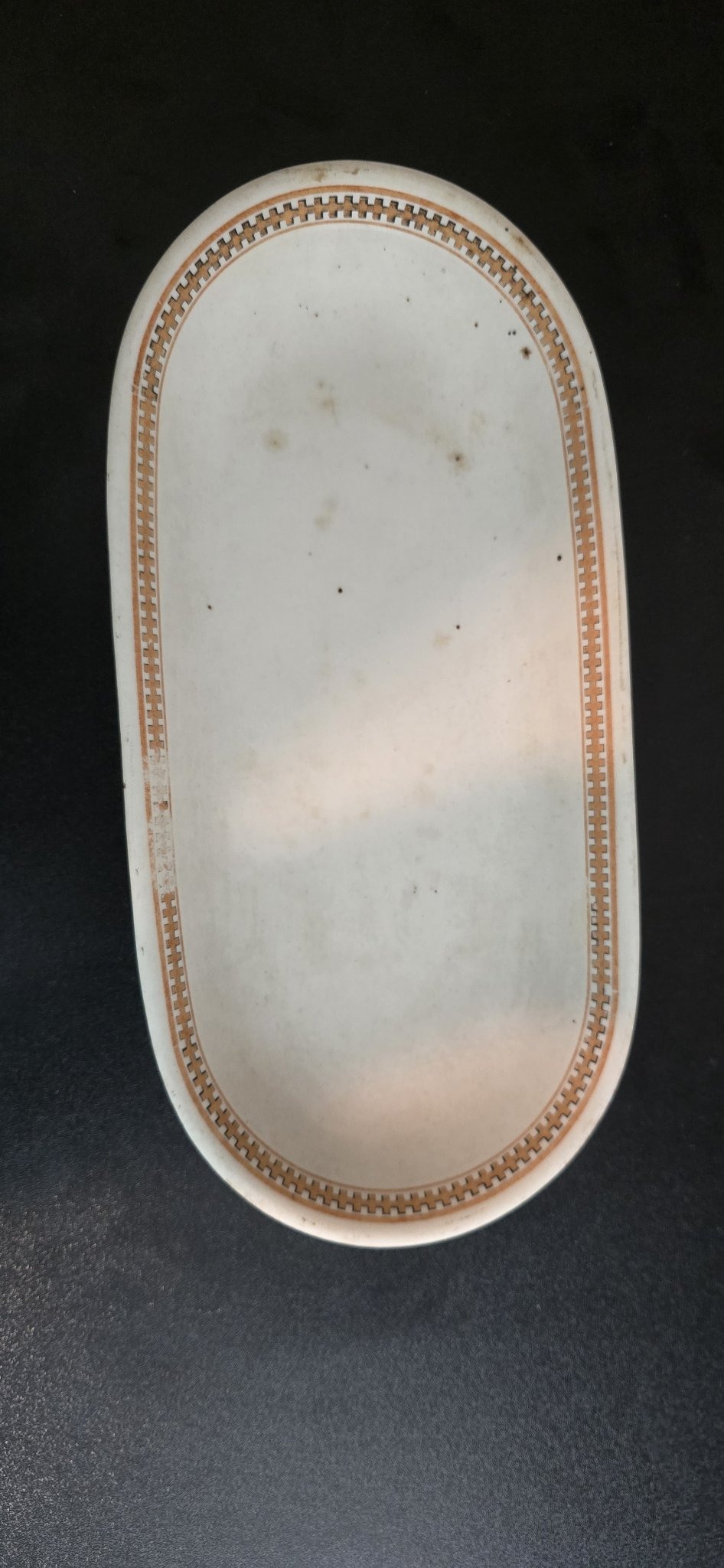
This is an oblong or oval ceramic tray featuring a white or off-white glazed ceramic body with a shallow, recessed center and gently sloping rims. The most prominent decorative feature is a continuous geometric border running just inside the inner perimeter of the tray. This border consists of an alternating pattern rendered in a metallic gilt or rust-orange enamel, resembling a Greek key or crenellated meander motif layered with small squares. The surface shows notable age-related wear, including several dark spotting stains, minor discoloration, and some fading or rubbing along the gilt patterned border, which is consistent with handling and vintage age. There are no clearly visible maker's marks, signatures, or backstamps discernible in the provided top-down photograph. The piece displays craftsmanship consistent with 19th- or early 20th-century European or Asian porcelain or ironstone vanity trays or dresser dishes, though without a physical inspection or a legible backstamp, its precise origin, manufacturer, and period remain unverified. The attribution rests entirely on the visual presentation and decorative style observed in the image.
AI Appraisal Report
Based on what I can see in the provided photograph, this oblong ceramic tray features a white glazed body and a geometric gilt or rust-orange border reminiscent of a Greek key motif. I can note that the piece exhibits age-related wear, including dark spotting stains, minor discoloration, and fading along the patterned border. However, I can't verify the exact composition, manufacturer, or period from a photo alone, and I would need physical inspection to confirm whether the body is porcelain, ironstone, or another ceramic medium. There are no clearly visible maker's marks, signatures, or backstamps discernible in the image, meaning the precise origin and date remain unverified working hypotheses. Assuming the piece is a 19th- or early 20th-century European or Asian vanity tray corresponding to this decorative style, comparable decorative ceramic items of this type typically trade in the $150 to $300 range, heavily dependent on the extent of condition issues like surface wear and staining. If the attribution is correct, this value reflects moderate collector demand for vintage dresser accessories. What would be needed to confirm authenticity and refine this estimate includes an in-person examination by a ceramics specialist, hallmark verification, and potential scientific testing or expert appraisal. If the item turns out to be a modern reproduction, replica, copy, or produced simply in the style of earlier wares, the market value would likely drop significantly, positioning the piece closer to $30–$75 as a purely decorative object.