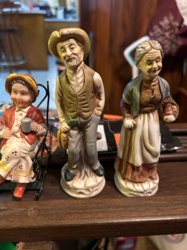
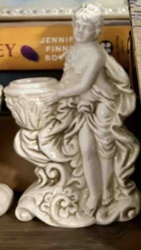
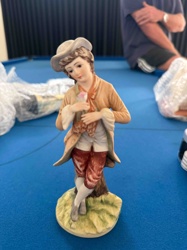
Bottom says 2MS or S could be a 5. Brand is holland mold excellent condition
These notes were written by the person who submitted this item. Appraiser.AI has not verified them, and the AI's identification and estimate may rely on them.
AI Estimated Value
Not an official valuation
$40-70
AI estimate as of October 30, 2025 · verify with a professional before acting
AI-Generated · Verify before acting
Everything on this page is generated by AI for informational purposes only. AI can make mistakes — the AI may misidentify items or misattribute them (artist, maker, brand, designer, origin, era). This is not an official valuation and should not be used for insurance, sale, tax, estate, legal, or lending purposes — or any decision requiring a certified appraisal. It is not an authoritative claim about any person, brand, or rights holder — do not share or rely on it as a factual statement about a third party. Always consult qualified professionals before making financial decisions.
This analysis also relies on unverified notes provided by the user, which may be incomplete or inaccurate and could affect the result.
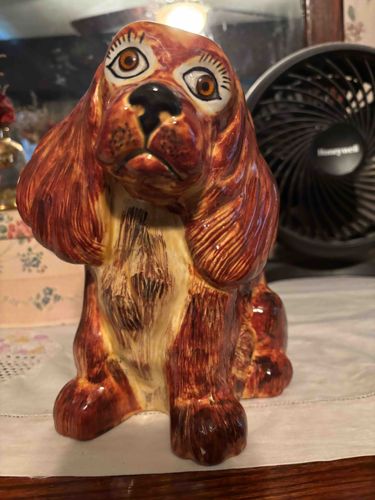
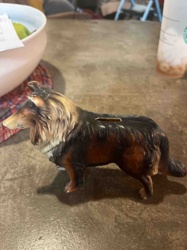
This item is a ceramic dog figure, specifically depicting a Cocker Spaniel, produced by Holland Mold. The figure is cast in a seated position with the dog looking forward, suggesting a calm and attentive demeanor. Its primary colors are various shades of reddish-brown, mimicking the rich fur of a Cocker Spaniel, with lighter cream or tan accents on the chest and around the face. The coloration exhibits a mottled or brindle-like effect, particularly on the ears and back, creating depth and a realistic fur texture. The eyes are a prominent feature, painted in brown with black pupils and distinct white outlines, giving the dog a wide-eyed, almost surprised expression. Stylized eyelashes are painted above and below the eyes. The nose is a solid black, contrasting with the lighter facial tones. The texture of the ceramic suggests a molded construction, with applied glaze providing a glossy finish across the entire surface. Evident brush strokes contribute to the appearance of individual strands of fur, especially on the large, floppy ears and the body. Based on the 'Holland Mold' attribution, this piece is likely from the mid to late 20th century, as Holland Mold was a popular supplier of ceramic molds for hobbyists and smaller studios during that period. The condition is described as 'excellent,' which suggests no significant chips, cracks, repairs, or noticeable crazing in the glaze, indicating careful preservation. The craftsmanship appears to be good quality for a molded ceramic piece, with clear details and a well-executed hand-painted finish that gives the item character. The notation '2MS or S could be a 5' on the bottom likely refers to a mold number or a batch identifier, common for ceramic mold companies.
AI Appraisal Report
Upon my virtual examination of the Holland Mold Ceramic Cocker Spaniel Dog Figure, I find it to be a charming decorative piece. The reported 'excellent' condition, with no chips, cracks, repairs, or significant crazing, is a strong positive for its value. The hand-painted details, including the notable eye treatment with white outlines and stylized lashes, and the brindle-like effect on the fur, demonstrate a good level of craftsmanship for a ceramic hobbyist piece from the mid-to-late 20th century. The '2MS or S could be a 5' on the bottom is consistent with Holland Mold's practice of numbering their molds.
Holland Mold pieces, while popular, were mass-produced molds for hobbyists, meaning many variations exist based on the painter's skill. This generally limits their upper market value. Current market conditions for vintage ceramic figures are stable, with demand for well-executed animal figures, though not exceptionally high. This specific piece isn't rare, given the widespread use of Holland Molds. Factors impacting value positively include its appealing subject matter (Cocker Spaniel) and excellent condition. Limitations in my authenticity verification exist as I have not physically handled the item. A physical examination would allow me to confirm the glaze quality, the absence of restoration, and the certainty of the mold markings. Provenance documentation, though unlikely for hobbyist ceramics, would further solidify its history. Without physical inspection, I cannot rule out minor surface inconsistencies or hairline crazing not visible in images.