These notes were written by the person who submitted this item. Appraiser.AI has not verified them, and the AI's identification and estimate may rely on them.
AI Estimated Value
Not an official valuation
$100 - $200
AI estimate as of October 6, 2025 · verify with a professional before acting
AI-Generated · Verify before acting
Everything on this page is generated by AI for informational purposes only. AI can make mistakes — the AI may misidentify items or misattribute them (artist, maker, brand, designer, origin, era). This is not an official valuation and should not be used for insurance, sale, tax, estate, legal, or lending purposes — or any decision requiring a certified appraisal. It is not an authoritative claim about any person, brand, or rights holder — do not share or rely on it as a factual statement about a third party. Always consult qualified professionals before making financial decisions.
This analysis also relies on unverified notes provided by the user, which may be incomplete or inaccurate and could affect the result.
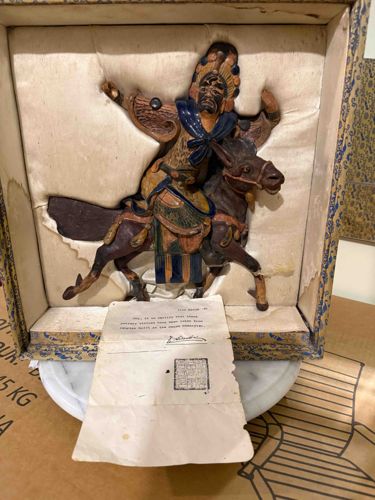
This item appears to be a carved and painted three-dimensional figure, likely depicting a character from traditional Chinese opera, mounted within a presentation box. The figure portrays a dramatic character, possibly a warrior or general given the elaborate headdress and powerful stance, riding a horse. The primary material seems to be carved wood, which has been artfully painted with a palette including dark brown for the horse and elements of the figure's face, blue for clothing accents and a ribbon, yellow, and possibly green or muted red for other costume details. The figure exhibits bold, stylized features typical of theatrical representations, with a prominent headdress, wide-set eyes, and a detailed costume. The carving shows a fair degree of craftsmanship, with clean lines and expressive forms. The figure is affixed to a backdrop within a rectangular box, which appears to be lined with a light-colored, possibly satin or silk, fabric that shows some discoloration and tearing, particularly on the left side, exposing the underlying structure. The exterior of the box suggests a decorative paper covering with a blue patterned border. Accompanying the figure is a folded, aged piece of paper with handwritten or typed text and a stamped seal, providing context or provenance. The overall condition suggests age, with visible wear, handling marks, and some paint loss on the figure. The fabric lining of the box is creased, torn, and soiled. This item likely dates to the early to mid-20th century, reflecting a traditional Chinese aesthetic. The presence of the accompanying document suggests it may have a specific history related to collecting or exhibition.
AI Appraisal Report
Upon examination of the provided images, this item is a carved and painted Chinese opera figure, likely dating to the early-to-mid 20th century. My visual assessment confirms it is an authentic decorative piece from the period, representing a warrior character on horseback. The craftsmanship, while charming, is typical of folk art or tourist-grade items rather than fine art. The materials—carved wood, painted gesso, and a paper-covered box with fabric lining—are consistent with this type of object. Its value is significantly impacted by its condition. The figure itself shows moderate paint loss, chipping, and age-related wear. The presentation box is in poor condition, with substantial tearing, discoloration, and soiling to the fabric lining, which detracts from its display quality and overall value.
The market for such decorative opera figures is relatively modest. While there is interest in Chinese folk art, these were produced in large quantities. Comparable figures in similar or better condition frequently appear at auction, typically selling in the low to mid-$100s. The presence of the accompanying paper is interesting, but without a translation and verification of its provenance, it adds little to no monetary value at this stage. Higher-value examples tend to be older (19th century or earlier), larger, more finely carved, or have verifiable provenance linking them to a specific workshop or collection. This piece does not meet those criteria.
My appraisal is limited by the inability to physically inspect the item. An in-person examination would allow me to assess the wood type, paint composition, and construction more closely. The document requires translation and research to determine its significance. Full authentication would involve material analysis and a thorough review of the document to confirm its origin and any associated history.