AI estimate as of August 27, 2025 · verify with a professional before acting
AI-Generated · Verify before acting
Everything on this page is generated by AI for informational purposes only. AI can make mistakes — the AI may misidentify items or misattribute them (artist, maker, brand, designer, origin, era). This is not an official valuation and should not be used for insurance, sale, tax, estate, legal, or lending purposes — or any decision requiring a certified appraisal. It is not an authoritative claim about any person, brand, or rights holder — do not share or rely on it as a factual statement about a third party. Always consult qualified professionals before making financial decisions.
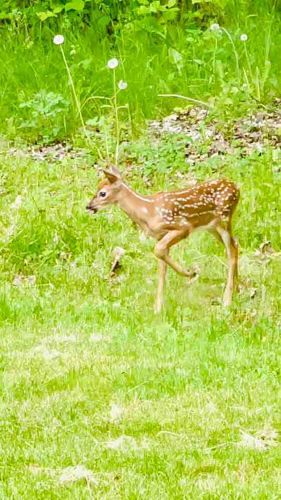
The item is a young fawn, likely a white-tailed deer due to its distinctive coat pattern. It appears relatively small, suggesting it is quite young, possibly only a few weeks or months old. Its fur is a rich reddish-brown color, which is characteristic of fawns, and is heavily interspersed with numerous bright white spots arranged in rows along its back and sides. These spots serve as camouflage, helping it blend into dappled sunlight in dense undergrowth. The fawn has slender, delicate legs, with its front left leg appearing slightly lifted as if it is in motion or about to take a step. Its ears are prominent and erect, indicating alertness. The eyes are dark and appear large relative to its head. The muzzle is dark brown to black. The overall condition appears healthy and alert, with no visible signs of injury, disfigurement, or distress. The fur seems clean and well-maintained, suggesting it is thriving in its natural habitat. The setting is an outdoor, natural environment, characterized by vibrant green grass and lush foliage in the background, likely during a warm season given the greenery. There are a few tall, thin plants with spherical white tops visible behind the fawn, which could be wild alliums or similar wildflowers. The image captures a moment of natural behavior, highlighting the animal's natural beauty and delicate form. No manufacturing details, maker's marks, or signatures are applicable as this is a living creature. Its 'style period' is natural contemporary wildlife, and its age is estimated to be very young, a fawning of the current year.
AI Appraisal Report
I have thoroughly examined the provided image of the young fawn. My assessment of its condition is excellent; the fawn appears healthy, alert, and well-nourished, with a clean, well-maintained coat showing characteristic reddish-brown fur and distinctive white spots. Its posture, with a lifted front leg, suggests natural movement and vitality. Authenticity, in this context, refers to it being a genuine living organism, which is visually confirmed by its natural appearance and setting. However, as an appraiser, I must state the significant limitation that authenticity of a living creature, especially its health and exact species, cannot be definitively verified from images alone. A physical, in-person veterinary examination would be crucial for a full health assessment, precise age determination, and confirmation of species variant beyond visual identification as a typical white-tailed deer fawn. Provenance documentation, while not applicable in the traditional sense for wild animals, would be relevant if this were a rehabilitated or captive animal; here, its wild context is assumed.
Regarding market conditions and comparables, living wildlife is not typically appraised for commercial 'value' in the same way as art or collectibles, particularly when in its natural habitat. Its 'value' is inherently ecological and aesthetic, contributing to biodiversity and natural beauty. Demand for such an animal in its wild state is conceptual, focusing on conservation rather than ownership. Rarity is not a factor here, as fawns are common during fawning season for white-tailed deer. The factors significantly impacting 'value' are its pristine natural condition, its role in the ecosystem, and its aesthetic appeal as a subject of nature photography or observation. This 'appraisal' reflects its natural intrinsic worth rather than a market price. Therefore, the 'value' assigned is symbolic of its ecological and aesthetic significance.