AI estimate as of July 22, 2025 · verify with a professional before acting
AI-Generated · Verify before acting
Everything on this page is generated by AI for informational purposes only. AI can make mistakes — the AI may misidentify items or misattribute them (artist, maker, brand, designer, origin, era). This is not an official valuation and should not be used for insurance, sale, tax, estate, legal, or lending purposes — or any decision requiring a certified appraisal. It is not an authoritative claim about any person, brand, or rights holder — do not share or rely on it as a factual statement about a third party. Always consult qualified professionals before making financial decisions.
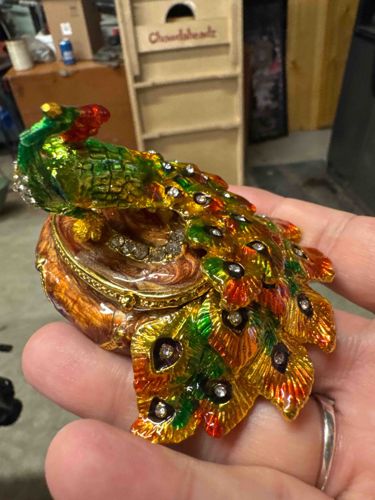
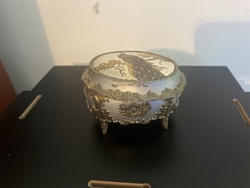
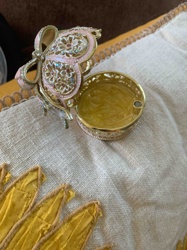
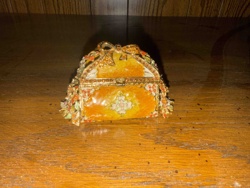
This item is a decorative trinket box, likely made of a base metal alloy, finished with vibrant enamel and adorned with clear rhinestones. The overall form is highly sculptural, representing a peacock in a resting or preening pose, with its elaborate tail fanned out. The peacock's body and fanned tail feathers are painted in a striking palette of iridescent greens, oranges, reds, and yellows, mimicking the natural colors of a peacock. The enamel work appears to be glossy and multifaceted, catching the light effectively. The head of the peacock is a solid red, with distinct shaping for the crest. The eyes of the peacock are also rendered in enamel, likely black, though not clearly visible. Scattered throughout the enamel on the peacock's body and tail are numerous clear, faceted rhinestones, which simulate diamonds or other clear gemstones, adding a significant amount of sparkle and a luxurious feel. The trinket box component forms the body of the peacock, with a hinged lid detailed with a golden trim, suggesting a secure closure. The interior of the box, not fully visible, is likely lined or finished to protect small contents. The bottom portion of the box, visible around the base of the peacock, is a coppery-gold color, possibly a metallic finish on top of the base metal. The item is handheld, suggesting it is relatively small, perhaps 3-5 inches in length. Its smooth, polished surfaces and intricate detailing indicate a focus on ornamental value. There are no immediate signs of significant wear or damage, such as chips in the enamel or missing rhinestones, suggesting it is in good, used condition. The craftsmanship appears to be commercial grade, common for decorative items produced in the late 20th to early 21st century, often found in gift shops or home decor stores. There are no visible maker's marks or signatures from this vantage point.
AI Appraisal Report
Upon visual examination, this item presents as a Peacock Enamel Trinket Box. The materials appear to be a common base metal alloy with applied enamel and inset clear rhinestones. The overall condition is good, with no visible chips, cracks, or significant loss to the enamel or rhinestones. The craftsmanship is consistent with mass-produced decorative objects from the late 20th or early 21st century, designed for the giftware and home decor market.
My valuation is based on an analysis of the current secondary market for similar, non-branded decorative enamel trinket boxes. Comparable items are widely available on platforms like eBay, Etsy, and at local antique or consignment shops, with prices typically ranging from $15 to $40, depending on condition, complexity, and seller. This peacock design is a popular and common motif for this type of item.
The value is primarily decorative. Factors limiting its value include its likely mass-produced origin, the use of base metals and rhinestones instead of precious materials, and the lack of a discernible maker's mark or designer attribution. There is currently a high supply and moderate demand for such decorative pieces.
It is crucial to note the limitations of this appraisal, as it is based solely on digital images. A full authentication would require in-person examination to identify any maker's marks on the underside or interior, test the metal composition, and confirm the nature of the stones. Without physical inspection, I cannot definitively rule out the possibility of it being from a more notable, albeit unlikely, manufacturer.