AI estimate as of July 28, 2025 · verify with a professional before acting
AI-Generated · Verify before acting
Everything on this page is generated by AI for informational purposes only. AI can make mistakes — the AI may misidentify items or misattribute them (artist, maker, brand, designer, origin, era). This is not an official valuation and should not be used for insurance, sale, tax, estate, legal, or lending purposes — or any decision requiring a certified appraisal. It is not an authoritative claim about any person, brand, or rights holder — do not share or rely on it as a factual statement about a third party. Always consult qualified professionals before making financial decisions.
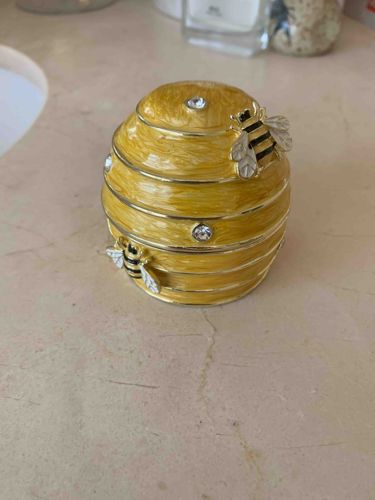
This item is a decorative trinket box, likely made from a metal alloy such as pewter or brass, coated with a vibrant yellow enamel. Its form is that of a traditional beehive, characterized by a rounded top and a series of horizontal ridges or bands that simulate the stacked rings often seen in beehive designs. Each of these ridges, as well as the top surface of the lid, is adorned with small, clear, faceted rhinestones or crystals, which are securely set and appear to sparkle, indicating their role as decorative accents. The yellow enamel finish has a subtle texture or brushstroke effect, adding depth to the color, and is bordered by thin, metallic gold or silver-toned lines separating each section, enhancing the beehive's structure. Two three-dimensional bee figurines are attached to the exterior – one on the upper part of the lid and another near the base. These bees feature black and yellow striped bodies, white or light-colored wings with visible veining details, and small black eyes, crafted with fine detail. The overall condition appears to be very good, with no visible chips, cracks, or significant wear to the enamel. The metallic accents, including the bees and the banding, show no signs of tarnish or significant scratching. The piece suggests a contemporary decorative style, likely produced in the late 20th or early 21st century. Its primary function is aesthetic and as a small storage container, possibly for jewelry or other tiny keepsakes. The craftsmanship appears to be of good quality, focusing on visual appeal and intricate details, particularly in the bee figures and the precise application of the rhinestones.
AI Appraisal Report
Upon visual examination of the Beehive Trinket Box with Rhinestones and Enamel, I assess its overall condition to be very good to excellent. The enamel appears vibrant and intact, with no observable chips or cracks. The rhinestones are all present and securely set, and the detailed bee figurines show no signs of damage. The metallic elements are free from significant tarnish or scratching. This piece presents as a modern decorative item, likely produced in the late 20th or early 21st century, and is consistent with mass-produced decorative objects often found in giftware markets.
The market for such trinket boxes is broad and highly competitive. Similar enamel and rhinestone-decorated boxes, often modeled after Faberge eggs or various animals, are widely available from numerous manufacturers. Based on comparable sales of similar non-branded, contemporary trinket boxes on online marketplaces and auction sites, the value is modest. The demand is steady but saturated, which keeps prices accessible. Its value is derived from its decorative appeal and good condition rather than from rarity, age, or manufacturer prestige.
It is crucial to note the limitations of this appraisal, as it is based solely on images. Without a physical inspection, I cannot confirm the base metal composition, the quality of the enamel and crystals, or identify any manufacturer's marks. A full authentication would require in-person examination to search for hallmarks or maker's insignias and to assess the craftsmanship firsthand. Testing the materials (e.g., XRF for metal content) would provide definitive identification but is not typically warranted for an item of this likely value.