AI estimate as of July 19, 2025 · verify with a professional before acting
AI-Generated · Verify before acting
Everything on this page is generated by AI for informational purposes only. AI can make mistakes — the AI may misidentify items or misattribute them (artist, maker, brand, designer, origin, era). This is not an official valuation and should not be used for insurance, sale, tax, estate, legal, or lending purposes — or any decision requiring a certified appraisal. It is not an authoritative claim about any person, brand, or rights holder — do not share or rely on it as a factual statement about a third party. Always consult qualified professionals before making financial decisions.
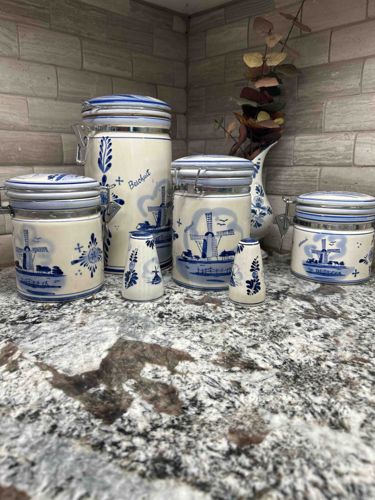
This is a Delft Blue style ceramic canister set, likely of Dutch origin or inspiration, designed for kitchen storage. The set comprises five varying sizes of canisters with hinged, airtight lids featuring wire bale closures and light blue rubber gaskets for sealing. Additionally, there are two smaller, cone-shaped items that appear to be salt and pepper shakers, making a total of seven pieces. All pieces are crafted from white ceramic or porcelain with hand-painted or transferware decorations in a distinctive cobalt blue. The primary motif across the larger canisters is a classic Dutch windmill scene, often depicted by water. One of the larger canisters is explicitly labeled 'Beschuit' (Dutch for rusks/biscuits), indicating its intended use. Other designs include floral or stylized patterns. The small shakers display simpler floral or geometric patterns. The craftsmanship appears good, with consistent application of the blue motif against the white base. The lids of the canisters have a light blue glazed surface with white stripes. The metal wire bail closures are silver-toned. The condition appears to be relatively good with no immediately visible chips, cracks, or significant wear. There might be some minor surface grime or dust from display, but the overall integrity of the ceramic and decoration seems well-preserved. Some slight variation in the intensity or texture of the blue coloring may be present, consistent with hand-decoration. The style suggests a mid-20th century to contemporary manufacturing period, aiming to replicate traditional Delftware aesthetics.
AI Appraisal Report
I have examined the provided image of the Delft Blue style ceramic canister and shaker set. Based on this visual inspection, the set appears to be in relatively good condition, with no immediately discernible chips, cracks, or significant wear. The consistency of the hand-painted or 'transferware' cobalt blue decoration on the white ceramic base is good, and the light blue glazed lids with white stripes are a pleasant aesthetic touch. The presence of 'Beschuit' on one canister indicates its Dutch inspiration or origin.
Authenticity, solely based on visual examination, is limited. While the style clearly emulates traditional Delftware, it's highly likely this is a mid-20th century to contemporary reproduction, not original 17th-18th century Delftware, judging by the consistent finish and modern appearance of the metal closures and rubber gaskets. True antique Delftware would show more signs of age, different construction techniques, and often, more refined hand-painting. To fully authenticate, I would need an in-person examination to verify the ceramic type, glazes, and decoration method (hand-painted vs. transferware), as well as to check for manufacturer's marks, which are not visible in the images. Provenance documentation could also help.<br>
In terms of market conditions, Delft Blue style kitchenware is generally popular but not exceptionally rare. Full sets like this, especially those explicitly labeled in Dutch, tend to hold more value than individual pieces. There is steady demand from collectors of kitchenalia and those decorating with traditional European styles. Comparables online suggest similar multi-piece sets range from lower-end contemporary imports to higher-quality vintage reproductions.
Factors impacting value include the number of pieces, excellent condition, and the explicit 'Beschuit' label, which adds to its charm and specificity. The primary limitation to a higher valuation is the absence of definitive signs of antique origin or a prominent manufacturer, and the general availability of such reproduction items.