AI estimate as of August 28, 2025 · verify with a professional before acting
AI-Generated · Verify before acting
Everything on this page is generated by AI for informational purposes only. AI can make mistakes — the AI may misidentify items or misattribute them (artist, maker, brand, designer, origin, era). This is not an official valuation and should not be used for insurance, sale, tax, estate, legal, or lending purposes — or any decision requiring a certified appraisal. It is not an authoritative claim about any person, brand, or rights holder — do not share or rely on it as a factual statement about a third party. Always consult qualified professionals before making financial decisions.
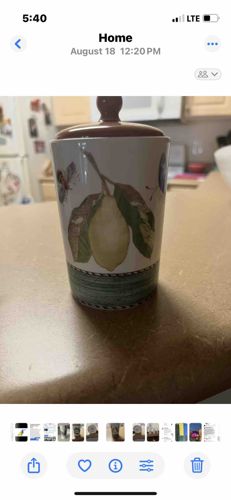
This item is a ceramic kitchen canister or storage jar, featuring a cylindrical body with a fitted lid. The main body of the canister is primarily off-white or cream colored, providing a neutral backdrop for the decorative elements. The central decoration depicts a large, ripe lemon or possibly a citron, with prominent green leaves, suggesting a botanical or fruit-themed design. To the left of the lemon, a multi-colored butterfly, likely in shades of purple and blue, is visible. The lower portion of the canister features a band of patterned decoration that appears to be horizontally ridged or textured in a muted green or teal color, resembling a basket weave or grooved pattern. This band is bordered by thin, dark lines, possibly brown or black, above and below. The lid of the canister is a warm, solid brown color, and it is topped with a small, rounded finial that serves as a handle. The material appears to be glazed ceramic, which provides a smooth, non-porous finish. The construction seems robust, indicating it's designed for practical use. There are no immediately visible signs of significant damage such as chips or cracks from the provided image, suggesting it is in good, used condition. The style points to a rustic or country kitchen aesthetic, likely from the late 20th century or early 21st century. No manufacturing marks or signatures are discernible in the image, but the craftsmanship appears to be of standard quality for mass-produced decorative kitchenware.
AI Appraisal Report
I have carefully examined the provided image of the Ceramic Lemon and Butterfly Kitchen Canister with Lid. Based on this visual inspection, the item appears to be in good, used condition with no immediately visible chips, cracks, or significant wear. The glazes retain their luster, and the decorative elements are intact. Authenticity, based on the image, points to a mass-produced ceramic kitchenware item. There are no discernible maker's marks or signatures, which is common for this type of decorative pottery.
Market conditions for decorative kitchen canisters of this style, often referred to as 'country' or 'rustic' decor, are generally stable but not experiencing significant appreciation. Comparable items from brands like Certified International or other mass-market producers typically retail new for \"$20-40\" per canister, depending on size and design complexity. In the secondary market (e.g., online marketplaces, estate sales), such items usually sell for less.
Demand for this specific motif (lemon and butterfly) is moderate. While pleasant, it doesn't represent a highly sought-after or rare design. This is a functional and decorative piece, but not a collectible with high rarity. Factors significantly impacting value include its mass-produced nature, lack of identifiable maker, and the commonality of its style. Without a brand name or artist attribution, its value is primarily as a utilitarian and decorative object.
It is important to note the limitations of assessing authenticity and condition from images alone. A physical examination would allow me to check for hairline cracks, chips not visible in the photo, crazing in the glaze, manufacturing flaws, and the overall quality of the ceramic body and paint application. Provenance documentation (e.g., original purchase receipts, designer/maker information) would be needed for full authentication to a specific manufacturer if one exists, as no marks are visible. Scientific testing is not typically applied to items of this nature as it would be cost-prohibitive and unnecessary for valuation.