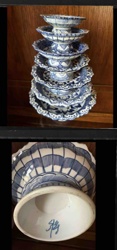
These notes were written by the person who submitted this item. Appraiser.AI has not verified them, and the AI's identification and estimate may rely on them.
AI Estimated Value
Not an official valuation
$450-700
AI estimate as of August 17, 2025 · verify with a professional before acting
AI-Generated · Verify before acting
Everything on this page is generated by AI for informational purposes only. AI can make mistakes — the AI may misidentify items or misattribute them (artist, maker, brand, designer, origin, era). This is not an official valuation and should not be used for insurance, sale, tax, estate, legal, or lending purposes — or any decision requiring a certified appraisal. It is not an authoritative claim about any person, brand, or rights holder — do not share or rely on it as a factual statement about a third party. Always consult qualified professionals before making financial decisions.
This analysis also relies on unverified notes provided by the user, which may be incomplete or inaccurate and could affect the result.
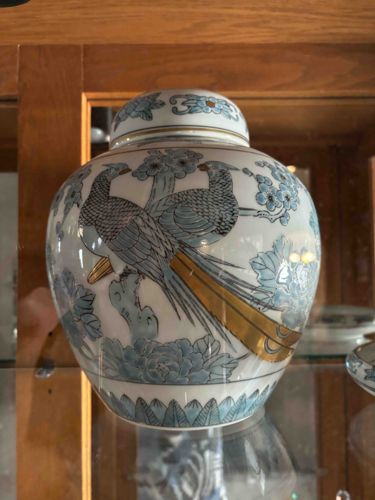
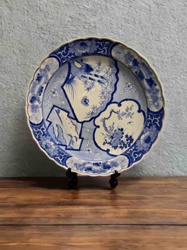
This is an Imari-style porcelain ginger jar with a lid, featuring a predominant blue and white palette with significant gold accents. The jar has a classic ovoid body, wide shoulders, a short neck, and a fitted domed lid with a small knob. The primary decoration on the body depicts two stylized birds, likely pheasants or peacocks, with intricately detailed plumage rendered in shades of blue. Their long tail feathers are highlighted with a prominent application of gold, indicating the 'Imari Gold' influence. Surrounding the birds are floral motifs, primarily peonies and flowering branches, also executed in various tones of blue on a white ground. The lid features a complementary floral or geometric pattern in blue. A thin gold band is visible at the rim of the jar and possibly on the lid's edge, adding to the luxurious feel. The base of the jar has a decorative border of blue stylized waves or geometric patterns, indicating quality craftsmanship. The porcelain appears to be well-fired with a smooth, glossy glaze. No obvious chips, cracks, or repairs are visible from the image, suggesting good overall condition with typical light wear commensurate with age. The distinct color palette of blues and gold on white, along with the specific bird and floral motifs, strongly identifies this piece as Japanese Imari ware, likely from the Meiji period or early 20th century, which is when this style was widely produced for export and highly prized.
AI Appraisal Report
Based on my examination of the provided image and the owner's description, this Japanese Imari-style Gold and Blue Porcelain Ginger Jar, featuring a prominent pheasant/peacock motif, appears to be an authentic piece likely dating from the Meiji period (1868-1912) or early 20th century. The consistent use of the 'Imari Gold' accents, particularly on the bird's plumage, combined with the classic blue and white palette and traditional floral motifs, aligns perfectly with the established characteristics of this highly collectible porcelain. The described condition, with no visible chips, cracks, or repairs and only light commensurate wear, is excellent for its age and contributes positively to its value.
Market conditions for quality Japanese Imari ware remain stable, with strong demand for well-preserved examples. Comparables typically include similar ginger jars or large vases from the Meiji period, with prices varying based on size, intricacy of decoration, and overall condition. The distinct bird motif adds to its aesthetic appeal and desirability. While the 'Imari Gold Japan' inscription provided by the owner suggests an export piece, typical of the period, full authentication without physical examination is limited. An in-person inspection would allow for an assessment of the porcelain's weight, tactile qualities, microscopic examination for glaze anomalies, and internal examination for any hidden repairs. Provenance documentation, such as original purchase receipts or family history, would further solidify its authenticity and value. Scientific testing, such as thermoluminescence dating, could provide a definitive age, though this is rarely pursued for pieces of this nature unless significant doubts arise.