AI estimate as of August 11, 2025 · verify with a professional before acting
AI-Generated · Verify before acting
Everything on this page is generated by AI for informational purposes only. AI can make mistakes — the AI may misidentify items or misattribute them (artist, maker, brand, designer, origin, era). This is not an official valuation and should not be used for insurance, sale, tax, estate, legal, or lending purposes — or any decision requiring a certified appraisal. It is not an authoritative claim about any person, brand, or rights holder — do not share or rely on it as a factual statement about a third party. Always consult qualified professionals before making financial decisions.
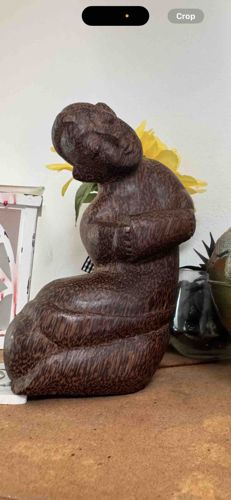
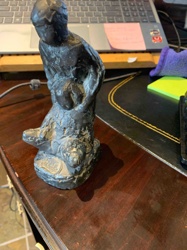
This is a hand-carved wooden sculpture depicting a figure, likely female, in a seated or crouching pose. The wood appears to be a dark, rich brown, possibly a tropical hardwood given its very prominent and consistent grain pattern that creates a textured, almost fibrous appearance across the entire surface. The figure is stylized, with simplified anatomical features. The head is relatively large in proportion to the body, with subtle indications of facial features, though they are not clearly defined in the visible image. The torso is robust, and the arms are bent, with hands resting in front of the body or on the lap, though the exact position is indistinct. The lower body is full and rounded, suggesting a seated or recumbent posture. There are no discernible markings, signatures, or stamps visible in the provided images that would indicate a specific maker or origin. The style suggests an ethnographic or folk art tradition, possibly from an African, Oceanic, or Latin American culture, focused on fertility or ancestral figures. The craftsmanship showcases a deliberate, perhaps rustic, carving technique, with the wood grain being a prominent aesthetic element rather than being smoothed over. The condition appears good, with no obvious signs of significant damage, cracks, or repairs. The rich color and textured surface suggest a well-maintained piece, perhaps with a natural patina that has developed over time, enhancing its dark tone. The estimated age is difficult to determine without more information but it appears to be a contemporary or mid-20th-century piece, rather than antique, given the lack of severe distress or heavy signs of age.
AI Appraisal Report
Based on my visual examination of the provided image, this hand-carved wooden sculpture appears to be in good condition. The prominent and consistent wood grain suggests a tropical hardwood, contributing significantly to its aesthetic. Its stylized form and robust features point towards an ethnographic or folk art tradition, potentially African or Oceanic, interpreting themes of fertility or ancestry. However, without tactile examination, I cannot definitively confirm the wood type or rule out minor surface damage. The authenticity of its origin as a true ethnographic piece, rather than decoratively inspired, is difficult to ascertain from images alone. A lack of visible signatures or markings further complicates origin identification.
In terms of market conditions, similar stylized wooden figures, particularly those without documented provenance or acclaimed artistic attribution, generally fetch modest prices in the broader art market. Demand exists within specific collectors of tribal art or folk art, but the absence of definitive cultural identification or known artist limits its broader appeal and value. Its rarity is not exceptional, as many such pieces were produced. Factors significantly impacting value include the lack of provenance, the absence of an identifiable artist or cultural group, and the inability to confirm its age beyond a mid-20th-century estimate. For full authentication and a more precise valuation, I would require a physical inspection to assess the wood, carving tools, and patina more accurately. Additionally, provenance documentation (e.g., acquisition history, exhibition records) and potentially scientific tests (e.g., carbon dating, wood analysis) would be crucial to confirm authenticity, origin, and age.