These notes were written by the person who submitted this item. Appraiser.AI has not verified them, and the AI's identification and estimate may rely on them.
AI Estimated Value
Not an official valuation
$800-1,200
AI estimate as of August 31, 2025 · verify with a professional before acting
AI-Generated · Verify before acting
Everything on this page is generated by AI for informational purposes only. AI can make mistakes — the AI may misidentify items or misattribute them (artist, maker, brand, designer, origin, era). This is not an official valuation and should not be used for insurance, sale, tax, estate, legal, or lending purposes — or any decision requiring a certified appraisal. It is not an authoritative claim about any person, brand, or rights holder — do not share or rely on it as a factual statement about a third party. Always consult qualified professionals before making financial decisions.
This analysis also relies on unverified notes provided by the user, which may be incomplete or inaccurate and could affect the result.
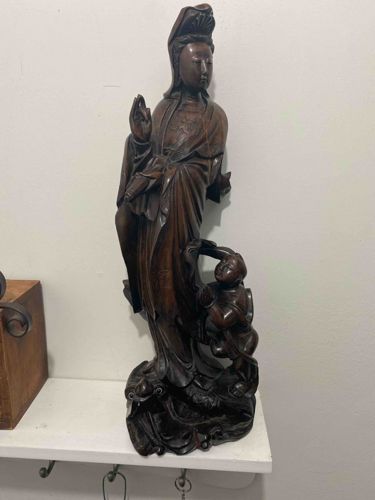
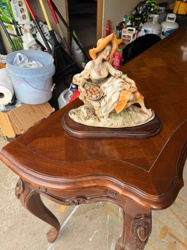
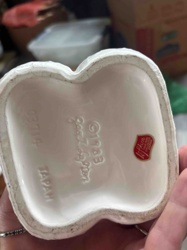
This is a detailed carved wooden statue depicting the Buddhist Bodhisattva Guanyin, often revered as the Goddess of Mercy, accompanied by a small attendant figure. The carving is rendered in a dark, rich brown wood, possibly mahogany or a similar hardwood, which exhibits a visible grain and a smooth, aged patina. The main figure of Guanyin is depicted standing, draped in flowing robes that cascade around her form, showing intricate folds and texture. Her right hand is raised in a gesture that appears to be a mudra (possibly the Abhaya Mudra, symbolizing fearlessness and protection), while her left arm is lowered, perhaps holding an object that is not clearly visible or simply resting. Her face is serene, with downcast eyes, a small mouth, and an elaborate coiffure or headdress that adds to her dignified appearance. The smaller figure, likely a child attendant often seen with Guanyin (such as Shancai or Longnü), clings to the robes of the main figure on her right side, facing upwards. This attendant figure is also intricately carved, showcasing a youthful, devotional posture. The base of the carving is integrated with the figures and features swirling, organic forms, possibly depicting clouds or waves, adding to the narrative and aesthetic cohesion of the piece. The overall craftsmanship suggests a skilled hand, with attention to detail in the drapery, facial features, and the interaction between the two figures. There are no immediately apparent signs of significant damage like cracks or chips; however, the typical wear and subtle darkening of the wood consistent with age are present, contributing to its vintage appeal. No visible maker's marks or signatures are discernible from the provided images. Given its style and the aged appearance of the wood, this carving is likely from the early to mid-20th century.
AI Appraisal Report
Upon visual examination of the provided images, this carved wooden Guanyin with attendant figure presents as a charming and well-executed piece. The dark brown wood, likely a hardwood given its visible grain and apparent density, exhibits a pleasing aged patina consistent with the early to mid-20th century dating provided. The craftsmanship is commendable, especially in the flowing drapery, serene facial features of Guanyin, and the intricate interaction with the small attendant. The integrated base with organic forms adds to its aesthetic completeness.
Condition appears good; there are no immediately visible cracks, chips, or significant damage. The subtle darkening and wear are typical of age and contribute positively to its vintage appeal.
In terms of market conditions, vintage Asian decorative arts, particularly well-carved Buddhist figures, maintain a steady demand. Comparable sales of similarly sized and aged carved wooden Guanyin figures of this quality typically fall within the $700-$1,500 range, with pieces showing exceptional detail or significant age fetching higher prices. This piece demonstrates good artistic merit, which enhances its desirability. While not exceedingly rare, a well-preserved piece of this size and detail is not commonplace.
A significant factor impacting value is the condition and artistic quality, both of which are strong here. The lack of visible maker's marks is common for pieces of this vintage and does not negatively impact value unless a specific renowned artisan is suspected.
Limitations in authenticity verification exist purely from images. While the visual cues strongly suggest a vintage piece, a forensic in-person examination would allow for tactile inspection of the wood's surface, precise weight assessment, and microscopic analysis of the patina and carving techniques to confirm age and rule out modern reproductions. Provenance documentation, such as original purchase receipts or family history, would further solidify its authenticity and history, though its absence is not detrimental to an appraisal of this nature.