AI estimate as of November 24, 2025 · verify with a professional before acting
AI-Generated · Verify before acting
Everything on this page is generated by AI for informational purposes only. AI can make mistakes — the AI may misidentify items or misattribute them (artist, maker, brand, designer, origin, era). This is not an official valuation and should not be used for insurance, sale, tax, estate, legal, or lending purposes — or any decision requiring a certified appraisal. It is not an authoritative claim about any person, brand, or rights holder — do not share or rely on it as a factual statement about a third party. Always consult qualified professionals before making financial decisions.
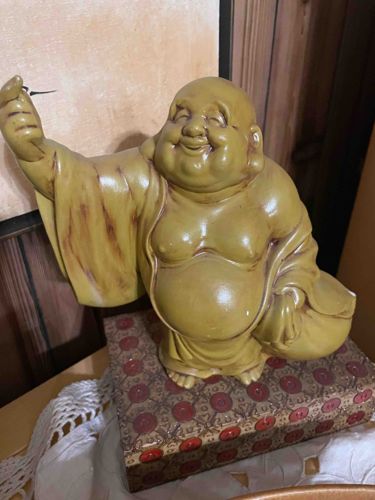
This is a statue depicting Hotei, commonly known as the 'Happy Buddha' or 'Laughing Buddha', characterized by his jovial expression, rotund belly, and typically happy demeanor. The statue appears to be made of ceramic or a resin-type material with a glossy, mustard-yellow or olive-toned glaze, showing some variations in shading that suggest an antique or aged patina. The construction seems solid, likely hollow cast given its size and typical manufacturing methods for such items. Hotei is depicted standing with his left arm raised and bent at the elbow, hand open as if waving or holding something small (a tiny dark object is visible between his index finger and thumb, possibly a fly or a small decorative element). His right arm is bent, holding a bag or sack over his shoulder, a traditional attribute signifying wealth or good fortune. He has a wide, beaming smile, closed eyes, and prominent earlobes. His robes are simple and draped, contributing to the figure's overall placid and welcoming appearance. There are no clearly visible manufacturing marks or signatures from the observation, but the finish suggests it could be a mass-produced decorative item, possibly from the mid to late 20th century. The quality of craftsmanship appears good, with well-defined features and a smooth finish. There are no obvious signs of significant damage such as cracks or chips, though minor surface wear consistent with age and handling might be present. The rich color and traditional pose make it a classic representation of Hotei.
AI Appraisal Report
Upon visual examination of the provided image, this Happy Buddha (Hotei) statue appears to be in good overall condition. There are no immediately apparent chips, cracks, or significant damage, which is a positive factor. The glossy, mustard-yellow or olive-toned glaze and variations in shading suggest an aged patina, consistent with a decorative item from the mid to late 20th century. The craftsmanship, with well-defined features and a smooth finish, indicates good quality for a mass-produced item.
Authenticity, in terms of its age and origin, is difficult to verify solely from an image. While it presents as a classic representation of Hotei, typical manufacturing methods for such figurines often involve ceramic or resin with a hollow cast, which this appears to be. Without direct physical inspection, I cannot confirm the exact material composition or the manufacturing process. There are no visible maker's marks or signatures, which is common for decorative pieces of this type and age.
Market conditions for Hotei statues, particularly those that appear mass-produced, are generally stable but not indicative of high value. Comparable items, often found in antique malls, thrift stores, or online marketplaces, typically range from $30 to $100 depending on size, material, and condition. This particular piece falls squarely within that decorative market segment. Demand for such items is consistent among collectors of Asian decor or those seeking auspicious symbols, but it is not rare.
Factors impacting value include its good condition and classic appeal. However, the likely mass-produced nature and absence of unique artistic elements or historical significance limit its upper value. For full authentication regarding its exact material, age, and potential origin, an in-person examination, including tactile inspection, detailed photography, and potentially even scientific testing (e.g., specific gravity for material identification), would be necessary. Provenance documentation, if available, would also significantly aid in establishing its history and confirming any claims of rarity or artistic attribution.