AI Appraisal Estimate

AI-generated estimates · not official valuations

From the user

What was submitted

Photo and notes provided by the user — not generated by AI

Submitted item photo
Submitted photo · June 6, 2026

User's notes

Lead figurine

AI analysis below

AI appraisal

AI analysis & estimate

AI-Generated · Verify before acting

Everything below is generated by AI for informational purposes only. AI can make mistakes — the AI may misidentify items or misattribute them (artist, maker, brand, designer, origin, era). This is not an official valuation and should not be used for insurance, sale, tax, estate, legal, or lending purposes — or any decision requiring a certified appraisal. It is not an authoritative claim about any person, brand, or rights holder — do not share or rely on it as a factual statement about a third party. Always consult qualified professionals before making financial decisions.

Note

This analysis also relies on unverified notes provided by the user, which may be incomplete or inaccurate and could affect the result.

Read the full disclaimer

AI Identification

·Not independently authenticated·Verify before acting

Vintage Lead Classical Female Figurine with Urn

Collectibles / Decorative Statues & Figurines

AI Estimated Value

·Not an official valuation·Verify before acting

$25.00 - $45.00

As of June 6, 2026

AI Item Analysis

·AI can make mistakes·Verify before acting
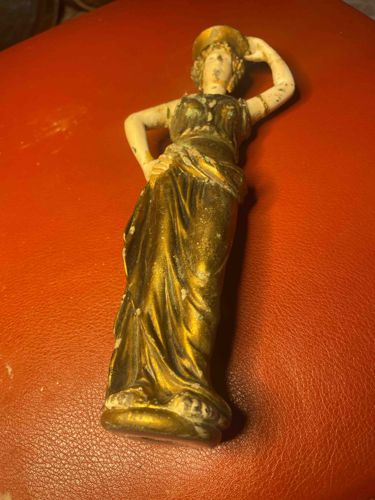
This is a vintage solid lead figurine depicting a female figure in classical Greco-Roman attire. The figure is posed as a 'water bearer' or caryatid-style character, holding a small vessel or urn atop her head with her left arm raised, while her right hand rests on her hip. The sculpture is characterized by flowing drapery that suggests a chiton or peplos, with heavy gold-tone paint applied over the metallic base. Physically, the item appears to be approximately 3 to 5 inches in height, constructed from a dense lead alloy consistent with early to mid-20th-century toy and decorative manufacturing. The gold-tone finish is significantly worn, revealing a dull grey metallic patina underneath, particularly on high-relief areas like the face, shoulders, and drapery folds. The face lacks fine definition, suggesting it was likely mass-produced through a casting mold. The condition shows significant paint loss, surface oxidation, and general pitting, which is typical for lead items of this age. There are no clearly visible maker's marks or signatures on the front, though such marks are often found on the base or rear of these pieces. The style is Neoclassical, likely manufactured between 1920 and 1950, reflecting the popularity of classical motifs in domestic decor during that era.
AI Appraisal Report

·AI can make mistakes·Verify before acting
I have virtually examined this vintage solid lead classical figurine, measuring approximately 3 to 5 inches. The item appears to be an authentic mass-produced decorative piece from the early-to-mid 20th century (circa 1920-1950). My assessment reveals significant condition issues: the gold-tone finish is heavily abraded, and the underlying lead alloy shows pitting and oxidation consistent with poor storage or environmental exposure. The lack of fine detail in the casting suggests these were produced for the middle-market domestic decor or possibly as a component of a larger garniture set. The current market for small, unsigned lead figurines of this type is relatively soft. While Neoclassical motifs remain a staple of interior design, collectors typically seek pieces with original 'cold-painted' finishes or those attributed to specific manufacturers like Frankart or JB Hirsch. Without a maker’s mark, this remains an anonymous 'shelf-dweller' piece. Rarity is low, as these were produced in high volumes using reusable molds. The primary factors suppressing value are the significant paint loss and the inherent health risks associated with lead-based items, which limits their appeal to a general audience. This appraisal is based solely on digital images. For a definitive authentication and valuation, a physical inspection is required to check for hidden marks on the base and to confirm the alloy's stability. In-person testing for lead rot (pest) would be necessary to ensure the structural integrity of the piece over time. Provenance documentation regarding its original manufacturer would provide the most significant potential for a valuation increase.

Get your items appraised

Instant estimates of your treasures with AI-powered appraisals

Browse More Appraisals