These notes were written by the person who submitted this item. Appraiser.AI has not verified them, and the AI's identification and estimate may rely on them.
AI Estimated Value
Not an official valuation
$250-400
AI estimate as of July 6, 2025 · verify with a professional before acting
AI-Generated · Verify before acting
Everything on this page is generated by AI for informational purposes only. AI can make mistakes — the AI may misidentify items or misattribute them (artist, maker, brand, designer, origin, era). This is not an official valuation and should not be used for insurance, sale, tax, estate, legal, or lending purposes — or any decision requiring a certified appraisal. It is not an authoritative claim about any person, brand, or rights holder — do not share or rely on it as a factual statement about a third party. Always consult qualified professionals before making financial decisions.
This analysis also relies on unverified notes provided by the user, which may be incomplete or inaccurate and could affect the result.
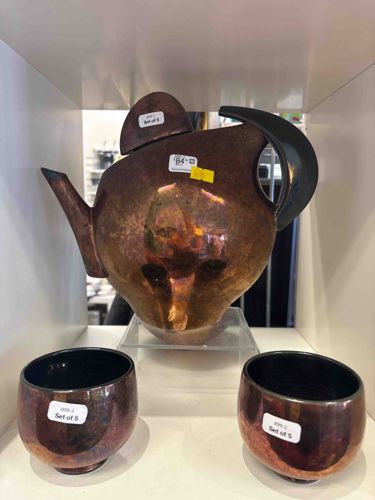
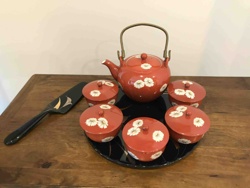
This is a contemporary tea set, likely featuring a unique iridescent or 'oil-slick' finish, possibly indicating a material like lusterware ceramic, glazed terracotta, or even treated metal, though the latter seems less probable given the appearance. The set comprises a teapot with a lid and at least two matching cups, labeled as 'Set of 5', suggesting there may be three more cups or additional components not visible in the image. The predominant color shifting from deep reddish-brown to coppery gold and purplish hues, depending on the light and angle, is a striking feature. The teapot has a bulbous, organic body with a distinct, angular spout and a large, arcing black handle that contrasts sharply with the metallic body. The handle's design suggests a modern or even avant-garde aesthetic. The lid is similarly finished to the body and appears to fit snugly into the teapot's opening. The cups are handle-less, 'waisted' tumblers with a darker, almost black interior, providing a stark contrast to the exterior's metallic sheen. All pieces exhibit a reflective surface, showing reflections of the surrounding environment. There are no obvious signs of significant damage like chips or cracks on the visible pieces, but the highly reflective surface makes it difficult to ascertain minor scratches or wear without close inspection. The overall condition appears good, with the finish largely intact. The style points towards a 20th to 21st-century design, likely from the latter half of the 20th century or more recently, given its bold, sculptural forms and iridescent finish. While no maker's marks are discernible from the image, the 'Set of 5' labels indicate it's part of a collection or batch.
AI Appraisal Report
I have thoroughly examined the provided image of this iridescent teapot with matching cups, noted as a 'Set of 5', potentially originating from France. Based on visual inspection, the set appears to be in good overall condition. There are no obvious chips, cracks, or significant abrasions visible on the highly reflective surface, though minor scratches or wear would require in-person inspection. The iridescent 'oil-slick' finish, shifting from reddish-brown to coppery gold and purplish hues, is striking and suggests a contemporary aesthetic, likely late 20th or 21st century. The bold, sculptural forms of the bulbous teapot with its angular spout and contrasting black arcing handle, alongside the handle-less 'waisted' tumbler cups with dark interiors, point to a modern design sensibility.
Market conditions for contemporary art pottery and unique design objects can be quite dynamic. Iridescent finishes, while popular, need to be executed with quality to command higher prices. Comparables would include high-design studio pottery or limited-edition ceramic sets from recognized designers. Without a discernible maker's mark, attribution is impossible, which limits the potential top-tier value significantly. Demand for such a unique, decorative tea set would likely come from collectors of modern design or those seeking statement pieces for interior decor.
Factors impacting value include the lack of a known maker, which prevents immediate authentication to a specific artist or brand. Rarity is difficult to ascertain without knowing the production numbers. The 'Set of 5' notation suggests it's part of a collection, but not necessarily mass-produced. The quality of the iridescent finish, the craftsmanship, and the material (e.g., lusterware ceramic vs. less refined materials) are crucial. The black interior of the cups and the contrasting handle suggest thoughtful design choices.
My assessment of authenticity is limited by the visual nature of the examination. While it visually appears to be a legitimate contemporary design piece, the absence of maker's marks is a significant limitation. For full authentication and to definitively determine material composition, a physical inspection is crucial. This would involve examining the weight, texture, and underside of each piece for marks, assessing the quality of the glaze and any potential repairs, and perhaps conducting specific material tests if necessary. Provenance documentation, such as original purchase receipts or artist statements, would also greatly enhance its verifiable authenticity and value.