AI estimate as of November 23, 2025 · verify with a professional before acting
AI-Generated · Verify before acting
Everything on this page is generated by AI for informational purposes only. AI can make mistakes — the AI may misidentify items or misattribute them (artist, maker, brand, designer, origin, era). This is not an official valuation and should not be used for insurance, sale, tax, estate, legal, or lending purposes — or any decision requiring a certified appraisal. It is not an authoritative claim about any person, brand, or rights holder — do not share or rely on it as a factual statement about a third party. Always consult qualified professionals before making financial decisions.
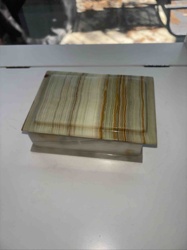
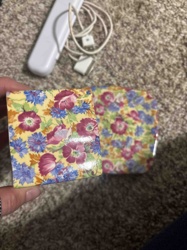
This appears to be a vintage wooden box, likely designed for jewelry or trinkets, based on its construction and interior lining. The box is rectangular with a hinged lid that is currently open, revealing the interior. The primary material seems to be a rich, dark brown wood, possibly mahogany or walnut, given its grain and hue. A striking feature is the inlay work visible on the edge of the lid, consisting of alternating light and dark wood segments arranged in a geometric or chevron pattern, adding an elegant decorative touch. The top surface of the lid also features a raised central panel, which seems to be made of a complementary or contrasting wood, possibly with some form of carving or marquetry that is difficult to discern clearly due to the image resolution and lighting. The interior of the box is lined with a padded, quilted fabric, which appears to be a muted blue or light green color, providing a soft protective cushion for its contents. This type of lining suggests the box was intended for delicate items. The box rests on a short, molded plinth-like base, indicative of a finer construction style. Condition-wise, the wood exhibits a noticeable sheen, suggesting it has been polished, but there might be some surface wear consistent with age, such as minor scratches or scuffs, though these are not distinctly visible. The overall aesthetic points towards an early to mid-20th-century style, possibly Art Deco or Arts and Crafts inspired due to the geometric inlay and solid construction. The craftsmanship, particularly the inlay work, indicates a degree of quality. No clear maker's marks or signatures are visible in the provided image.
AI Appraisal Report
Based on my visual examination of the provided image, this vintage wooden inlaid box appears to be in good to very good overall condition, consistent with its likely age. The rich, dark wood, possibly mahogany or walnut, shows a nice sheen, suggesting it has been well-maintained. The geometric inlay work on the lid's edge adds significant aesthetic appeal and indicates quality craftsmanship. The padded, quilted interior lining suggests its original purpose was for delicate items like jewelry or keepsakes. The molded plinth-like base further enhances its refined construction.
Authenticity, based solely on visual cues, points to an early to mid-20th-century origin, fitting within Art Deco or Arts and Crafts stylistic periods. There are no visible signs of significant damage such as major cracks, chips, or missing inlay segments, although minor surface wear (scratches, scuffs) typical of age cannot be definitively ruled out without a physical inspection. Fading of the interior fabric or wear to its padding are also possibilities outside of current visual confirmation.
In terms of market conditions, decorative wooden boxes of this quality, especially those with refined inlay work, tend to hold steady demand among collectors of vintage home decor and jewelry boxes. Comparables in the current market for well-preserved, finely crafted inlaid wooden boxes of this size and style typically range from $100 to $250. Factors impacting value include the specific wood type (difficult to confirm without in-person inspection), the intricacy and condition of the inlay, and the overall state of preservation. The absence of maker's marks or provenance documentation limits the upper end of its value, as a known maker would increase desirability.
My valuation of $120-200 reflects its good condition, attractive inlay, and presumed age. For full authentication and a more precise valuation, I would require a direct physical examination to assess the woods, inlay integrity, interior fabric condition, and to search for any subtle maker's marks or construction details not visible in photographs. Provenance documentation, if available, would also be invaluable.