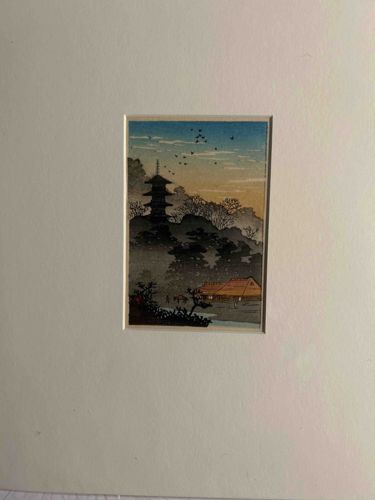
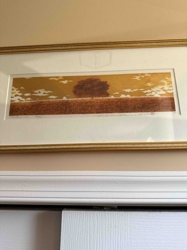
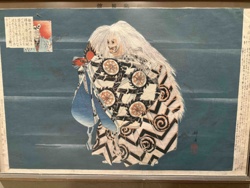
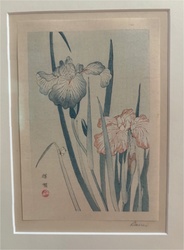
Shotei “ evening glow on pagoda and deep wood. Japanese wood block print from 1930.
These notes were written by the person who submitted this item. Appraiser.AI has not verified them, and the AI's identification and estimate may rely on them.
AI Estimated Value
Not an official valuation
$400-700
AI estimate as of November 3, 2025 · verify with a professional before acting
AI-Generated · Verify before acting
Everything on this page is generated by AI for informational purposes only. AI can make mistakes — the AI may misidentify items or misattribute them (artist, maker, brand, designer, origin, era). This is not an official valuation and should not be used for insurance, sale, tax, estate, legal, or lending purposes — or any decision requiring a certified appraisal. It is not an authoritative claim about any person, brand, or rights holder — do not share or rely on it as a factual statement about a third party. Always consult qualified professionals before making financial decisions.
This analysis also relies on unverified notes provided by the user, which may be incomplete or inaccurate and could affect the result.
This item is a Japanese woodblock print by Shotei (Hiroaki Takahashi), titled 'Evening Glow on Pagoda and Deep Wood,' dating from approximately 1930. The print depicts a serene evening landscape featuring a multi-tiered pagoda silhouetted against a fading sky. The sky transitions from a light, clear blue at the top, populated by a flock of birds, to warmer hues of orange and yellow near the horizon, indicative of an evening glow. The pagoda and surrounding trees are rendered in dark, almost black tones, suggesting dusk or twilight. A distinctive feature is a traditional Japanese building with an illuminated, orange-hued roof situated in the lower right portion of the image, possibly a tea house or dwelling, with faint figures discernible nearby. The 'deep wood' aspect is conveyed through dense foliage depicted around the pagoda and in the mid-ground. The print utilizes a limited but effective color palette, emphasizing atmospheric perspective and the contrast between light and shadow. The details are relatively fine, typical of Japanese woodblock print craftsmanship, with distinct lines and color blocks. The print is currently housed within a white mat board frame, indicating it is prepared for display, which covers a small border around the print itself. There are no immediately visible condition issues on the print itself such as tears, significant discoloration, or foxing, although a close-up examination would be required to confirm. The edges of the print appear sharp and well-defined, suggesting good preservation. The overall aesthetic is one of tranquility and natural beauty, characteristic of Shotei's work and the Shin-hanga movement.
AI Appraisal Report
Based on my visual examination of the provided image and the owner's description, this Shotei (Hiroaki Takahashi) woodblock print, 'Evening Glow on Pagoda and Deep Wood,' appears to be a genuine example from around 1930. The aesthetic qualities, limited color palette, and atmospheric perspective are consistent with Shotei's characteristic style and the Shin-hanga movement. The print's detail and color blocks suggest typical woodblock craftsmanship. The presence of a white mat board frame ready for display indicates a degree of care in its presentation.
From the image, the condition appears excellent. I observe no obvious tears, significant discoloration, foxing, or creasing. The colors seem vibrant, and the print edges look sharp and well-defined. This favorable condition positively impacts its value.
Market conditions for Shotei prints remain strong, driven by consistent demand from collectors of Shin-hanga art. Prints of this size and subject matter by Shotei typically fetch values in the mid-hundreds, particularly those depicting atmospheric landscapes. Comparable sales for well-preserved, popular Shotei designs often fall within the $400-$800 range, with exceptional examples potentially exceeding this. Demand is steady, and while Shotei's prints are not exceedingly rare, desirable subjects in fine condition are always sought after. The serene beauty of this specific composition enhances its appeal.
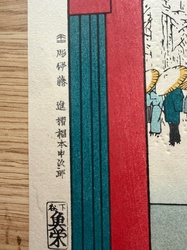
It is crucial to note that while the visual characteristics are convincing, a definitive authentication requires an in-person examination. I would need to inspect the paper type, watermarks, exact printing quality, and any publisher seals (such as Watanabe) that might be hidden by the mat. Such details are vital for confirming authenticity and assessing the impression's quality (e.g., early vs. later impression). Provenance documentation, if available, would further solidify its history and value. Without these, my appraisal is based solely on visual inspection and general market trends.