AI estimate as of November 3, 2025 · verify with a professional before acting
AI-Generated · Verify before acting
Everything on this page is generated by AI for informational purposes only. AI can make mistakes — the AI may misidentify items or misattribute them (artist, maker, brand, designer, origin, era). This is not an official valuation and should not be used for insurance, sale, tax, estate, legal, or lending purposes — or any decision requiring a certified appraisal. It is not an authoritative claim about any person, brand, or rights holder — do not share or rely on it as a factual statement about a third party. Always consult qualified professionals before making financial decisions.
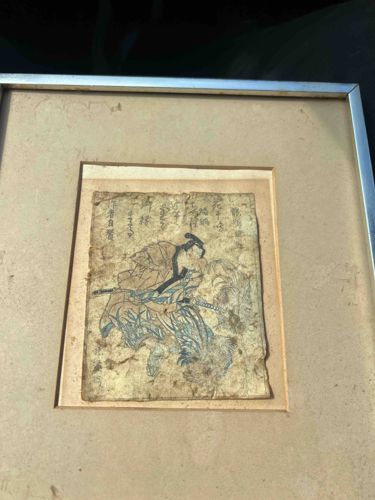
This item is a framed fragment of what appears to be a Japanese woodblock print, possibly from the Edo or Meiji period, given the style of the figure and the characteristics of the paper. The print measures approximately 5-6 inches in height and 4-5 inches in width (estimated visual dimensions, exact measurements not possible from images), and is set within a matting and a narrow silver-colored metal frame. The depicted figure is an individual, likely a male, rendered in traditional Japanese attire, possibly a samurai or character from folklore, given the presence of what appears to be a sword or long bladed weapon at their side, oriented horizontally along the waist area. The colors visible in the print are muted, consisting primarily of black ink for outlines and text, and accents of faded blue or teal. The background appears to be a very aged, light brown or ecru color. Visible kanji characters are present in vertical columns on the upper left and right sides of the print, suggesting it is a section of a larger work or a page from a book. The paper itself shows significant signs of age and degradation, including substantial discoloration, yellowing, and dark brown spotting / foxing throughout. The texture appears coarse and fibrous, indicative of handmade paper. Edges of the print are uneven and worn, with some fraying and minor losses, particularly visible on the right edge and bottom right corner. The matting surrounding the print is a light beige or off-white color and shows some staining or discoloration, especially in the upper right corner where a small dark spot and lighter brown marks are visible. The metal frame is a simple profile with a brushed or polished finish, exhibiting minor wear consistent with handling but no significant damage. The craftsmanship of the original print, despite its heavily aged condition, suggests a traditional woodblock technique, characterized by clean lines and distinct color blocks. The overall presentation indicates an attempt to preserve and display what is considered a historical or artistic fragment.
AI Appraisal Report
Upon visual examination of the provided image, I assess this framed Japanese woodblock print fragment to be a genuine artifact, likely from the late Edo or Meiji period, based on the figure's traditional attire, the presence of kanji, and the characteristic woodblock technique. However, its authenticity as a historically significant piece is limited by its fragmented nature and poor condition. The paper exhibits significant deterioration, including severe discoloration, foxing, fraying, and minor losses, which significantly impact its aesthetic appeal and preservation value. The muted blue/teal accents and black outlines are visible, but faded. The matting also shows staining.
Market conditions for such highly fragmented and degraded prints are generally low. While complete, well-preserved prints from these periods can fetch considerable sums, a small, heavily damaged fragment like this does not typically attract significant collector interest. Comparables would include other heavily damaged or partial ukiyo-e prints, which often sell in the lower tens to low hundreds of dollars, if at all, to niche collectors or for decorative purposes. Demand for fragments is limited due to their compromised artistic integrity and historical context. The rarity of the original complete print is unknown, but as a fragment, its rarity is not a value-driving factor.
Without in-person examination, I cannot definitively ascertain the precise paper type, ink composition, or confirm the exact period with absolute certainty. Physical inspection would allow for tactile assessment of the paper's texture and fiber, and clearer identification of printing methods. Provenance documentation, detailing the print's history and origin, would be crucial for full authentication and to potentially enhance its value, even as a fragment. Scientific testing could verify paper age and ink composition. Given its current state and lack of verifiable history, its value is primarily decorative or as a curiosity.