AI Appraisal Estimate

AI-generated estimates · not official valuations

From the user

What was submitted

Photo and notes provided by the user — not generated by AI

Submitted item photo
Submitted photo · June 13, 2026

User's notes

No additional notes provided.

AI analysis below

AI appraisal

AI analysis & estimate

AI-Generated · Verify before acting

Everything below is generated by AI for informational purposes only. AI can make mistakes — the AI may misidentify items or misattribute them (artist, maker, brand, designer, origin, era). This is not an official valuation and should not be used for insurance, sale, tax, estate, legal, or lending purposes — or any decision requiring a certified appraisal. It is not an authoritative claim about any person, brand, or rights holder — do not share or rely on it as a factual statement about a third party. Always consult qualified professionals before making financial decisions.

Read the full disclaimer

AI Identification

·Not independently authenticated·Verify before acting

Hand-Painted Ruffled Opalescent Art Glass Bud Vase

Decorative Art Glass

AI Estimated Value

·Not an official valuation·Verify before acting

$120-180

As of June 13, 2026

AI Item Analysis

·AI can make mistakes·Verify before acting
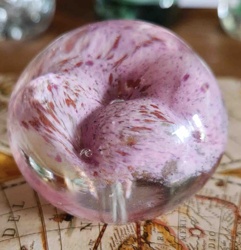
This item is a decorative bud vase crafted from opalescent art glass, featuring a distinctive ruffled rim and hand-painted floral motifs. The vase displays an inverted bell or trumpet shape, tapering towards a narrower base. The primary color of the glass appears to be a milky white, which transitions to a vibrant rose pink hue on the interior and exterior of the vigorously ruffled and scalloped top edge. This pink coloration on the rim exhibits a slight opalescence, giving it a soft, ethereal glow. The body of the vase is adorned with hand-painted decorations, consisting of a prominent stylized purple flower, possibly a daisy or aster, with a stippled white and yellow center. Green leafy tendrils gracefully curve around the flower, extending downwards and featuring small white dot accents. The painting style suggests a delicate, almost folk-art aesthetic, with visible brushstrokes adding character. The construction appears to be blown glass, given the smooth, curved surfaces and uniform thickness where visible. There are no obvious visible condition issues such as chips, cracks, or significant wear to the paint, suggesting it is in good to excellent vintage condition. The style and craftsmanship, particularly the opalescent glass and hand-painting, suggest a late 19th to early 20th-century origin, possibly Victorian or Edwardian era art glass, reminiscent of Moser or Fenton pieces, though without a clear maker's mark, precise attribution is difficult. The overall form and decoration indicate it was intended as a decorative accent piece for holding a single flower or small bouquet.
AI Appraisal Report

·AI can make mistakes·Verify before acting
Based on my visual examination of the Hand-Painted Ruffled Opalescent Art Glass Bud Vase, the condition appears to be good to excellent. I observe no chips, cracks, or significant paint loss, which suggests careful preservation. The opalescent glass, transitioning from milky white to rose pink on the vigorously ruffled rim, is a desirable feature. The hand-painted stylized purple flower with green tendrils and white dot accents is charming, indicative of late 19th to early 20th-century aesthetic, possibly Victorian or Edwardian art glass. This style is often associated with makers like Fenton or Moser, though without a clear maker's mark or signature, direct attribution remains challenging from images alone. Market conditions for such decorative art glass are generally stable for well-preserved, attractive examples. Comparable sales of unmarked opalescent, hand-painted bud vases from this period typically fall within the $100-$200 range, with prices fluctuating based on decoration quality and condition. Demand is steady among collectors of antique art glass and decorative home accents. While not exceedingly rare, pieces in excellent condition like this one are always sought after. The primary factor impacting value is the lack of a definitive maker's mark; a confirmed attribution to a prominent manufacturer would significantly increase its value. My appraisal is limited by the visual nature of the assessment. Full authentication, including definitive maker identification, would require in-person examination, potential blacklight testing for repairs, and a thorough review of any provenance documentation. Scientific testing, if available, could further confirm glass composition and age. Without these, the attribution to a specific maker remains speculative.

Get your items appraised

Instant estimates of your treasures with AI-powered appraisals

Browse More Appraisals