AI estimate as of December 11, 2025 · verify with a professional before acting
AI-Generated · Verify before acting
Everything on this page is generated by AI for informational purposes only. AI can make mistakes — the AI may misidentify items or misattribute them (artist, maker, brand, designer, origin, era). This is not an official valuation and should not be used for insurance, sale, tax, estate, legal, or lending purposes — or any decision requiring a certified appraisal. It is not an authoritative claim about any person, brand, or rights holder — do not share or rely on it as a factual statement about a third party. Always consult qualified professionals before making financial decisions.
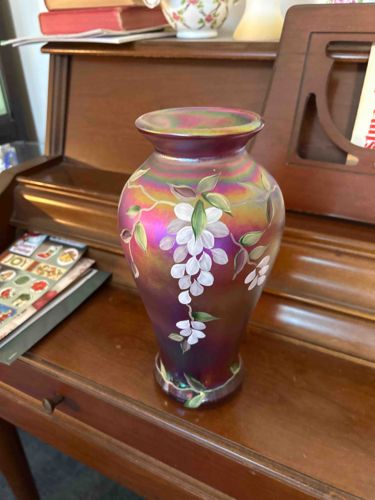
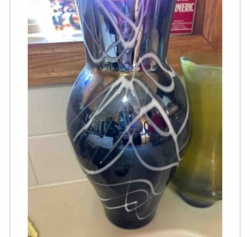
This is an iridescent art glass vase, featuring a vibrant play of colors that shift with the light, primarily displaying tones of magenta, gold, green, and purple. The vase has a classic, slightly flared rim and a gently tapering body that widens slightly towards the base, which is then subtly constricted before leading to a short, round foot. It appears to be made of blown glass, exhibiting a smooth, lustrous surface. The most prominent decorative feature is the hand-painted motif of white wisteria blossoms with delicate green leaves and tendrils, trailing downwards from the upper portion of the vase. The brushwork for the flowers appears fine and detailed, suggesting a skilled artisan. There are no visible chips, cracks, or significant abrasions on the surface, indicating good overall condition. The iridescent finish itself serves as a hallmark of late 19th to early 20th-century art glass production, often associated with makers like Tiffany, Loetz, or Kralik, though no specific maker's mark is discernible from the image. The style suggests an Art Nouveau or Art Deco influence, depending on the exact age and origin. The craftsmanship of both the glass blowing and the painting appears to be of good quality, contributing to its aesthetic appeal. The base has further painted foliage, reinforcing the overall floral theme. The vase has a refined, elegant presence and would have been used for decorative purposes or for holding small floral arrangements.
AI Appraisal Report
Based on my visual examination of the provided image, this iridescent art glass vase with hand-painted wisteria decoration presents in very good overall condition. I observe no visible chips, cracks, or significant abrasions on the surface, which is crucial for art glass. The lustrous iridescent finish, showcasing magenta, gold, green, and purple tones, appears intact, and the hand-painted wisteria motif is well-preserved with fine detail, indicative of skilled artistry. The form suggests blown glass, consistent with late 19th to early 20th-century Art Nouveau or Art Deco aesthetics, a period highly sought after in decorative arts. The full floral theme, extended to the base, enhances its decorative appeal.
Market conditions for quality iridescent art glass, especially those with intricate hand-painted designs, remain robust. While not reaching the peak prices of named masters like Tiffany without verifiable attribution, pieces exhibiting superior craftsmanship and condition are consistently desirable. Comparables within the 'unmarked art glass' category, often attributed to Bohemian houses like Lötz or Kralik, or American art glass producers, with similar decorative quality and iridescence, typically fetch within the $600-$900 range, sometimes exceeding $1,000 for exceptional examples or particularly vibrant iridescence. Demand for decorative antique and vintage art glass remains stable among collectors and interior designers. The rarity of an exact design is hard to gauge without historical records, but the quality of execution implies a piece that would have been premium and less common even at its time of manufacture.
My primary limitation in authentication and definitive value assessment stems from examining images alone. I cannot physically assess the weight, tactile quality of the glass, pontil mark details, or subtle variations in iridescence that would be critical for confirming a specific maker or origin. Furthermore, the absence of a discernible maker's mark prevents an immediate attribution to a renowned studio, which would significantly impact value. For full authentication and to potentially identify the maker, an in-person examination by an art glass specialist, including close inspection of the base and any hidden marks, microscopic analysis of the paint and glass, and potentially provenance documentation, would be necessary.