AI estimate as of August 10, 2025 · verify with a professional before acting
AI-Generated · Verify before acting
Everything on this page is generated by AI for informational purposes only. AI can make mistakes — the AI may misidentify items or misattribute them (artist, maker, brand, designer, origin, era). This is not an official valuation and should not be used for insurance, sale, tax, estate, legal, or lending purposes — or any decision requiring a certified appraisal. It is not an authoritative claim about any person, brand, or rights holder — do not share or rely on it as a factual statement about a third party. Always consult qualified professionals before making financial decisions.
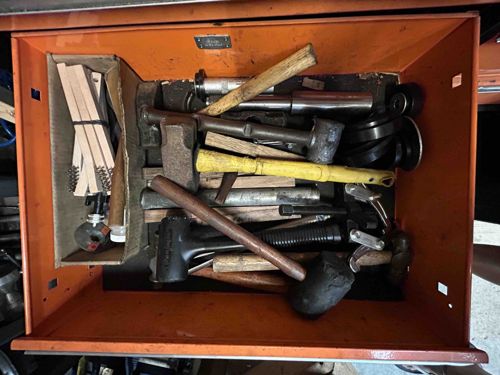
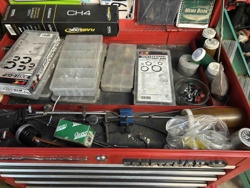
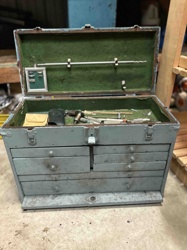
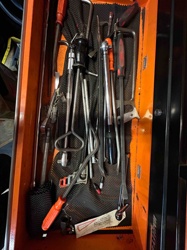
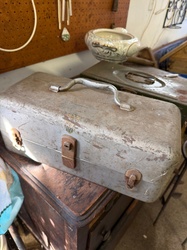
This item is an open, orange-colored metal toolbox drawer, likely part of a larger tool storage system. The drawer is rectangular, with sturdy metal construction, exhibiting an aged and somewhat industrial appearance. The interior of the drawer is filled with a disorganized assortment of various hand tools and related components, suggesting a working environment where tools are frequently used.
Observable tools include multiple hammers of different sizes and types, some with wooden handles (one appearing to be a ball-peen hammer with a dark, possibly rubberized handle, and another with a distinctly yellow handle), and others with metal heads. There are also several wooden blocks or wedges, varying in size and possibly used as shims or for striking. A bundle of what appears to be small wooden or plastic sticks, perhaps dowels or cleaning rods, is visible on the left side, bound together with a black elastic band. Various metal shafts, potentially punches, drifts, or specialized automotive/machinery components, are scattered throughout. Several small, round, black objects resembling bearings or seals are also present. One peculiar item is a small glass bottle with a clear liquid and a brush applicator, likely for lubricants or solvents. Wear and tear are evident across many items, with scuffs, scratches, and a general layer of grime visible on both the tools and the interior of the drawer. Some tools show signs of heavy use, such as chipped or worn striking surfaces on the hammers, and tarnishing on metal components. The overall condition suggests regular utility in a workshop or garage setting rather than pristine display. No specific manufacturer's marks are clearly discernible on the tools or the drawer itself from this perspective. The collection of tools appears functional and diverse, typical of a professional or hobbyist who performs mechanical or repair work. The estimated age is difficult to pinpoint without specific markings, but the style of some tools and the overall patina suggest they could be several decades old, originating from the mid-to-late 20th century.
AI Appraisal Report
I have carefully examined the image of this Assorted Hand Tools in an Orange Toolbox Drawer. My assessment indicates a collection of heavily used, functional hand tools. The orange metal toolbox drawer itself appears robust, albeit aged, consistent with mid-to-late 20th-century workshop equipment. The tools, including various hammers, wooden blocks, metal shafts, and small components, exhibit significant wear, scuffs, scratches, and a layer of grime, confirming their history of active use rather than display. The presence of a glass bottle with a brush applicator further suggests a working environment.
Authenticity, based solely on visual examination, appears to be of genuine vintage tools and tool drawer, not reproductions. However, without handling the items, I cannot verify material composition or internal integrity. The lack of discernible manufacturer's marks prevents specific dating or identification of high-value brands. The condition is fair to poor for individual tools, but the collective utility is still present. Market conditions for used, unbranded hand tools are generally modest; such items are typically sold by weight or in bulk at garage sales, estate sales, or online marketplaces. While there’s continuous demand for functional tools for hobbyists or professionals, these particular items lack rarity or collector appeal due to their common nature and distressed condition.
The value is primarily in their utility and scrap potential. Factors significantly impacting value are the lack of brand recognition, the heavily worn condition, and the disorganization, which would necessitate cleaning and sorting by a buyer. If these tools were from a renowned manufacturer or in better condition, the value would be higher.
Limitations in authenticity verification from images alone are significant. A physical inspection would be crucial to determine the type and quality of metal for the tools, assess handle integrity, confirm the composition of the small objects (bearings/seals), and check for operational defects. Provenance documentation, such as receipts or inheritance records, would be necessary for any claims of historical significance. Scientific testing, like material analysis, would confirm metal alloys or wood types, further aiding in dating and value assessment, especially if there were suspicions of rare materials or historical significance.