AI estimate as of November 8, 2025 · verify with a professional before acting
AI-Generated · Verify before acting
Everything on this page is generated by AI for informational purposes only. AI can make mistakes — the AI may misidentify items or misattribute them (artist, maker, brand, designer, origin, era). This is not an official valuation and should not be used for insurance, sale, tax, estate, legal, or lending purposes — or any decision requiring a certified appraisal. It is not an authoritative claim about any person, brand, or rights holder — do not share or rely on it as a factual statement about a third party. Always consult qualified professionals before making financial decisions.
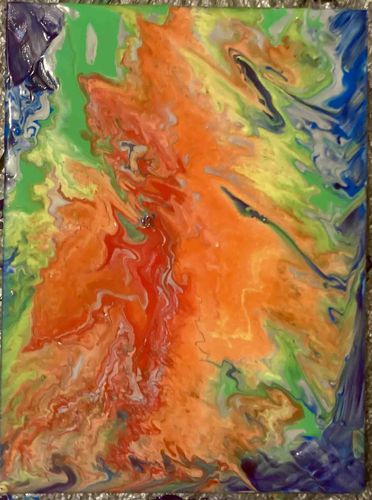
This item is an abstract artwork created using the acrylic pour technique. The canvas appears to be rectangular, oriented vertically, and of a moderate size, likely a common pre-stretched canvas. The dominant colors in the composition are vibrant orange and bright green, with accents of yellow, blue, red, purple, and white/gray. The colors are intertwined in organic, fluid patterns characteristic of paint pouring, where various shades flow into and over each other to create cells and lacing effects. Notably, there are visible textural variations where the paint has dried, showing some areas with higher relief and glossy finishes due to the medium used (likely a pouring medium mixed with acrylic paints). Certain areas, particularly in the central orange and reddish-orange region, exhibit a shimmering or metallic quality, possibly due to glitters or metallic pigments mixed into the paint. The edges of the canvas appear to be clean, suggesting the pour was contained or wrapped around the sides neatly. There are no discernible artist signatures or marks visible in the provided image. The overall condition appears good, with no obvious signs of damage, cracks, or flaking, maintaining the glossy finish inherent to the technique. The style is contemporary abstract, indicating a likely creation period from the late 20th century to the present. The craftsmanship reflects the controlled chaos of the acrylic pour, with a successful balance of color distribution and cell formation, which are indicators of a skilled pour artist.
AI Appraisal Report
I have examined the provided image of the Abstract Acrylic Pour Painting. The condition appears to be excellent, with no visible damage, cracks, or flaking, and it retains its intended glossy finish. Authenticity of the artwork itself as an acrylic pour is clear from the visual characteristics; however, authenticity regarding the artist is impossible to verify from an image alone, especially without a visible signature.
This piece falls into the highly competitive contemporary abstract market. Acrylic pour paintings, while visually striking, are generally prolific due to the technique's accessibility. The vibrant colors and successful cell formation indicate good craftsmanship for this medium. However, the absence of an artist signature, established provenance, or exhibition history significantly limits its market appeal beyond decorative value.
Demand for such unsigned, emerging artist works is primarily driven by aesthetic appeal as a home decor item rather than an investment piece. Rarity is not a factor here due to the technique's widespread popularity.
Factors significantly impacting value are the lack of artist identification and provenance. Without an acclaimed artist attached, the value remains in the lower tier for original art.
For full authentication of authorship and to understand its place in an artist's oeuvre, an in-person examination would be required to look for subtle signatures, framing, and medium specifics. Verification of provenance documentation (purchase receipts, artist statements) and potential scientific testing for specific pigments or mediums would be crucial, none of which is possible from an image.