AI estimate as of August 13, 2025 · verify with a professional before acting
AI-Generated · Verify before acting
Everything on this page is generated by AI for informational purposes only. AI can make mistakes — the AI may misidentify items or misattribute them (artist, maker, brand, designer, origin, era). This is not an official valuation and should not be used for insurance, sale, tax, estate, legal, or lending purposes — or any decision requiring a certified appraisal. It is not an authoritative claim about any person, brand, or rights holder — do not share or rely on it as a factual statement about a third party. Always consult qualified professionals before making financial decisions.
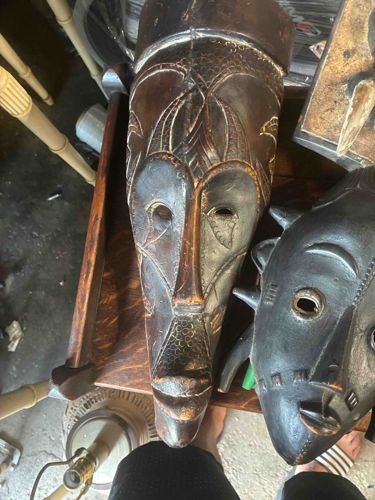
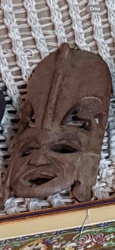
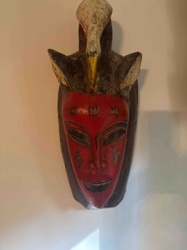
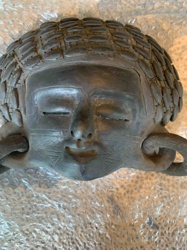
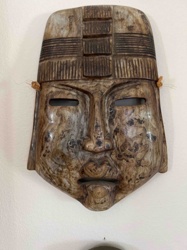
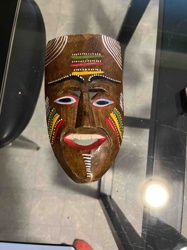
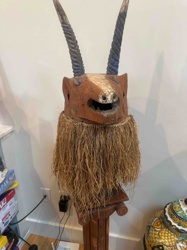
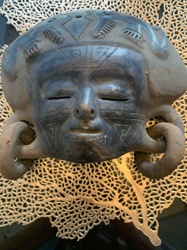
This appears to be a carved wooden ceremonial mask, likely of African origin, characterized by its elongated, oval form and dark, rich reddish-brown finish. The mask features recessed eyeholes, a prominent, narrow nose, and a delicately sculpted mouth. Intricate, incised patterns are visible across much of the mask's surface, particularly on the forehead and around the eyes, suggesting stylized tribal or natural motifs. These patterns appear to have a lighter, almost whitewashed or lightly stained infill, creating a striking contrast against the darker wood. The craftsmanship indicates hand-carving, and while specific maker's marks are not discernible, the details suggest an indigenous artistic tradition. There is a visible crack or split running vertically along the nose and potentially extending into the forehead area, which is a significant condition issue. Other areas might show wear consistent with age and handling, such as minor chips or scratches, and a natural patina would be expected. The overall construction is solid, though the crack suggests vulnerability. This mask likely belongs to the mid to late 20th century, given the apparent craftsmanship and absence of specific signs of extreme age or modern mass production, though without more historical context, a precise age is difficult to ascertain. The quality of carving is good, showcasing skilled handiwork.
AI Appraisal Report
Based on my visual examination, this African elongated ceremonial mask appears to be a skillfully hand-carved piece, likely from the mid to late 20th century. The elaborate incised patterns with lighter infill show good craftsmanship and are decorative. The overall condition is fair to good, with a significant vertical crack running along the nose and possibly into the forehead being the primary detractor. Minor wear, chips, and a natural patina are also present, consistent with age and handling.
In terms of market conditions, decorative African masks, especially those without established provenance, typically fall within a broad price range. While the carving quality is good, the lack of specific tribal attribution, known artist, or documented history limits its appeal to serious collectors seeking ethnographic authenticity. It would likely appeal more to a decorative arts market. Comparable items on the market, such as other mid-20th-century decorative African-style masks with similar age and condition issues, generally fetch modest prices. The crack significantly impacts its value, reducing its aesthetic appeal and structural integrity.
Demand for such decorative pieces is moderate, but true rarity is low without specific historical or cultural context. For full authentication and to ascertain true ethnographic value, an in-person examination is crucial. This would allow for tactile inspection of the wood, analysis of patina, and closer scrutiny of carving techniques. Provenance documentation, such as collection history or cultural origin, would be essential to elevate its standing beyond a decorative piece. Scientific testing (e.g., carbon dating, wood analysis) could confirm age and origin. Without these, I must limit my appraisal to its decorative and artistic merit.