AI estimate as of October 3, 2025 · verify with a professional before acting
AI-Generated · Verify before acting
Everything on this page is generated by AI for informational purposes only. AI can make mistakes — the AI may misidentify items or misattribute them (artist, maker, brand, designer, origin, era). This is not an official valuation and should not be used for insurance, sale, tax, estate, legal, or lending purposes — or any decision requiring a certified appraisal. It is not an authoritative claim about any person, brand, or rights holder — do not share or rely on it as a factual statement about a third party. Always consult qualified professionals before making financial decisions.
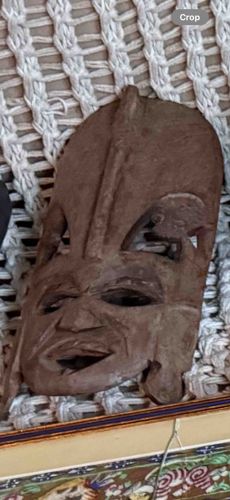
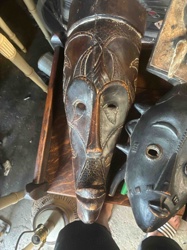
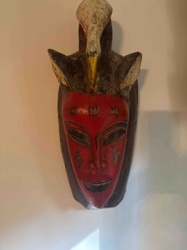
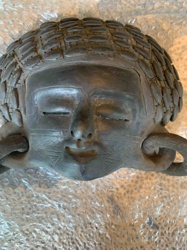
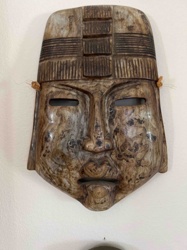
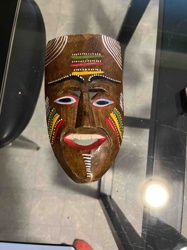
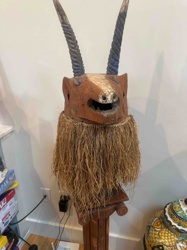
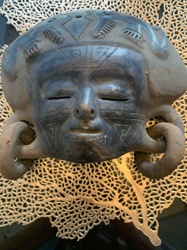
This is a carved wooden mask displaying characteristics often associated with African tribal art. The mask is primarily dark brown, suggesting a natural wood finish, possibly stained or aged. It features a stylized human-like face with deeply carved eyes that appear hollow, a prominent nose, and an open mouth revealing teeth or gums. The facial features convey an expressive, somewhat grimacing or surprised emotion. Above the forehead, there's an elaborate headdress-like element with a central ridge or crest running vertically, flanked by what appear to be simplified animal figures or abstract forms. On the right side, integrated into the headdress, is a distinct carving of a bird, possibly an eagle or hawk, with its head facing downwards towards the mask's face. The carving style is robust, with visible tool marks and a somewhat rough, tactile surface, indicating hand-carved craftsmanship. The mask shows signs of age and wear consistent with an older piece or one intended to mimic antique tribal art. There are no obvious glaring damages such as large cracks or repairs visible in the provided image, but the overall patina suggests handling and exposure over time. It appears to be a decorative or ceremonial mask, likely intended for wall display based on the context of the image. The specific origin or tribe is not discernible without further information, but it falls within the broad category of African or African-inspired masks. The quality of the carving, while not extremely fine, demonstrates skill in shaping the wood and capturing expressive features.
AI Appraisal Report
Based on my visual examination of the provided image, this carved wooden mask displays characteristics often associated with African tribal art. The dark brown finish and visible tool marks suggest hand-carved craftsmanship. The condition appears good for a decorative piece, with an evident patina suggesting age or intentional antiquing. There are no obvious major damages like cracks or repairs discernible from the image, but surface wear is consistent with handling over time.
Regarding authenticity, it is crucial to note that from images alone, definitive authentication as a genuine tribal artifact from a specific culture for ceremonial use is not possible. While it possesses features common to African-inspired masks, it could be a contemporary decorative piece or a tourist art item, which often mimics traditional styles to varying degrees of fidelity. The 'robust' carving style, while skilled, doesn't immediately point to a specific master carver or tribe without further context. Comparing it to known genuine tribal masks, this piece lacks the specific iconography or wear patterns that would consistently denote a true ceremonial artifact.
Market conditions for genuine tribal art vary widely, but for decorative pieces of this nature, demand is moderate. Comparables in the decorative art market, often found in 'ethnic arts' sections of galleries or online, range significantly based on perceived quality, size, and seller reputation. Without provenance (history of ownership) or a clear tribal attribution, its value leans towards that of a decorative artifact rather than a prime collectible tribal piece. Factors impacting value are primarily its aesthetic appeal and craftsmanship as a decor item.
For full authentication, an in-person examination would be critical to assess the wood type, construction methods, and microscopic signs of age and use. Scientific testing (e.g., carbon dating for the wood) could provide age confirmation. Most importantly, provenance documentation, such as collection history or expert attribution to a specific tribe or carver, would be essential to elevate its status beyond a decorative piece. As a result, its value as an evocative decorative mask is in the range of $100-250.