AI Appraisal Estimate

AI-generated estimates · not official valuations

From the user

What was submitted

Photo and notes provided by the user — not generated by AI

Submitted item photo
Submitted photo · May 27, 2026

User's notes

No additional notes provided.

AI analysis below

AI appraisal

AI analysis & estimate

AI-Generated · Verify before acting

Everything below is generated by AI for informational purposes only. AI can make mistakes — the AI may misidentify items or misattribute them (artist, maker, brand, designer, origin, era). This is not an official valuation and should not be used for insurance, sale, tax, estate, legal, or lending purposes — or any decision requiring a certified appraisal. It is not an authoritative claim about any person, brand, or rights holder — do not share or rely on it as a factual statement about a third party. Always consult qualified professionals before making financial decisions.

Read the full disclaimer

AI Identification

·Not independently authenticated·Verify before acting

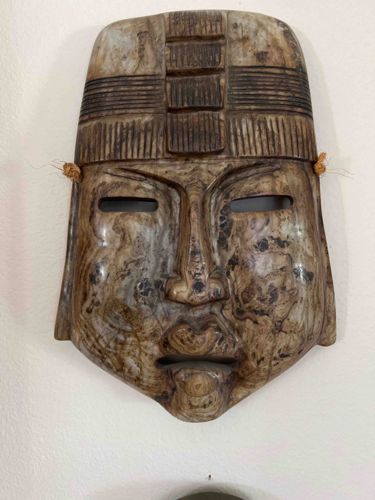
Teotihuacan-Style Stone Ritual Mask

Cultural Artifacts & Ethnographic Art

AI Estimated Value

·Not an official valuation·Verify before acting

$400 - $650

As of May 27, 2026

AI Item Analysis

·AI can make mistakes·Verify before acting
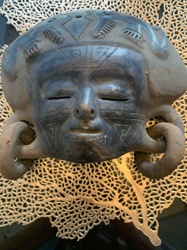
This item is a hand-carved decorative mask styled after the Teotihuacan culture of ancient Mesoamerica. It is crafted from a polished, mottled hardstone, likely a marbled onyx, travertine, or serpentine, exhibiting a complex palette of cream, tan, and dark brown swirled mineral inclusions. The mask features a monumental, geometric aesthetic with a tall, flattened headdress characterized by horizontal and vertical incised bands and three prominent rectangular recessed panels. The facial features are classically stylized with narrow horizontal eye slits, a straight-edged nose with defined nostrils, and an open, square-formed mouth revealing a slight protruding chin or tongue element. The ears are represented by simple vertical rectangular flanges on the sides. Two small holes are drilled near the temple area, through which remains of a natural fiber or twine hanging cord are visible. The craftsmanship displays high-quality polishing on the facial planes contrasted with more rustic, textured incising in the headdress. Condition-wise, the mask appears intact with no large cracks or structural repairs visible; however, there is significant minor surface pitting, some edge wear along the bottom jawline, and natural stone fissures that are consistent with aged decorative stonework. This is likely a mid-20th-century artisan reproduction intended for the ethnographic art market rather than a pre-Columbian artifact, given the specific tool-mark precision and surface treatment.
AI Appraisal Report

·AI can make mistakes·Verify before acting
I have carefully examined the Teotihuacan-style ritual mask. My assessment suggests this is a high-quality mid-20th-century decorative piece rather than a pre-Columbian artifact from the Classic period (c. 150-650 CE). The stone—a mottled travertine or 'Mexican Onyx'—exhibits attractive mineralization, but the precision of the square-cut mouth and the regularized mechanical feel of the headdress incising are indicative of modern lapidary tools. The surface pitting appears to be a mix of natural stone porosity and intentional 'distressing' to mimic age. The market for 'In the Style of' ethnographic art remains steady for interior design and mid-century modern collectors. While it lacks the historical rarity of an authenticated artifact, its monumental scale and craftsmanship make it a desirable decorative object. Comparables for high-end vintage Mexican stonework often fall within the mid-to-high three-figure range, depending on the specific weight and stone variety. Several factors limit this appraisal. Verification of authenticity via digital images is inherently incomplete. To elevate this item from a decorative reproduction to a potentially authentic antiquity, a physical examination by an archaeologist or specialized appraiser is required to check for microscopic tool marks (lithic vs. metal) and mineral patination (caliche buildup). Furthermore, provenance documentation tracing the item before the 1970 UNESCO Convention would be essential for legal sale as an antiquity. Without such documentation and scientific testing—such as thermoluminescence on any associated ceramics or mineralogical analysis of the stone—the value remains seated in its aesthetic and decorative merit.

Get your items appraised

Instant estimates of your treasures with AI-powered appraisals

Browse More Appraisals