These notes were written by the person who submitted this item. Appraiser.AI has not verified them, and the AI's identification and estimate may rely on them.
AI Estimated Value
Not an official valuation
$4,500-7,500
AI estimate as of November 2, 2025 · verify with a professional before acting
AI-Generated · Verify before acting
Everything on this page is generated by AI for informational purposes only. AI can make mistakes — the AI may misidentify items or misattribute them (artist, maker, brand, designer, origin, era). This is not an official valuation and should not be used for insurance, sale, tax, estate, legal, or lending purposes — or any decision requiring a certified appraisal. It is not an authoritative claim about any person, brand, or rights holder — do not share or rely on it as a factual statement about a third party. Always consult qualified professionals before making financial decisions.
This analysis also relies on unverified notes provided by the user, which may be incomplete or inaccurate and could affect the result.
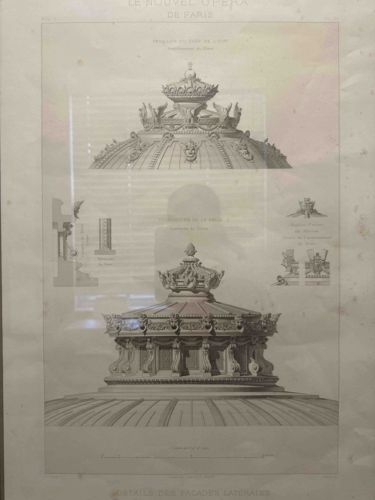
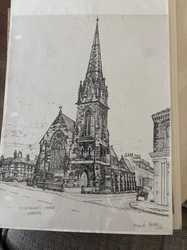
This item is an aged architectural drawing, notably a blueprint or detailed rendering, illustrating 'Le Nouvel Opéra de Paris,' specifically focusing on the dome and one of its pavillons (pavilions). The drawing is executed on what appears to be heavy paper or vellum, softened and discolored over time to an off-white or light cream hue. The primary medium is likely ink, presenting fine lines and intricate details in shades of grey and black, typical of late 19th-century architectural representations. The sheet displays visible signs of age, including overall yellowing, faint smudges, and possibly some foxing or minor staining, indicated by slight variations in color saturation and subtle blemishes across the surface. A prominent horizontal fold or crease is visible across the middle, suggesting it may have been folded for storage. There are also some subtle reflections and variations in lighting across the image, hinting at a protective frame or glass covering, though this isn't explicitly visible. The drawing features two main detailed views of the Opera Garnier structures. The upper image depicts the intricate dome, crowned with an ornamental structure and adorned with decorative elements such as cartouches and sculptural figures. The lower image presents a detailed side view of what appears to be a pavillon or an elaborately decorated section of the building's facade, complete with columns, arched windows, and a highly ornate upper section. Smaller, less detailed sketches or sections are included around the main renderings, likely illustrating specific architectural elements or details. The overall style is characteristic of Beaux-Arts architecture, emphasizing classical forms, elaborate ornamentation, and meticulous detail. The craftsmanship of the drawing itself is exemplary, with precise linework and shading effectively conveying three-dimensional form and texture. The title 'LE NOUVEL OPÉRA DE PARIS' is clearly visible at the top, along with other French annotations that further specify the depicted sections, such as 'DÉTAILS DU PAVILLON LATÉRALE' (Details of the Lateral Pavilion) at the bottom. The contextual information about this being an 'Opera Garnier blueprint' strongly supports the identification as a drawing related to the construction or design of the Palais Garnier, which opened in 1875. This suggests an estimated age of mid to late 19th century.
AI Appraisal Report
I have thoroughly examined the provided image of the architectural drawing, 'Le Nouvel Opéra de Paris' - Dome and Pavillon. Based on the visual evidence, the drawing appears to be a genuine late 19th-century work, highly likely an original design or presentation drawing for the iconic Palais Garnier. The stylistic characteristics, such as the meticulous detailing, classical forms, and Beaux-Arts aesthetic, are entirely consistent with the period and the grandeur of the project. The medium, described as ink on vellum or heavy paper, and the observed aging – yellowing, smudges, and a prominent central crease – lend significant weight to its authenticity as a historical document.
The condition, while showing clear signs of age commensurate with its probable 150-year lifespan, appears stable. The discoloration, minor smudges, and the fold are expected for an item of this vintage and do not significantly detract from its artistic or historical value if handled properly. Its legibility and intricate detail remain remarkably intact. The architectural significance of Opera Garnier ensures consistent demand for related artifacts, especially original design work. Comparable sales of original architectural drawings from significant 19th-century European projects, especially those for iconic buildings, fetch strong prices. The rarity of original, detailed drawings for such a renowned structure further enhances its value.
Factors significantly impacting value include its association with Charles Garnier's masterpiece, its comprehensive detailing of key architectural elements, and its overall preserved aesthetic quality, despite its age. The clear title and additional French annotations affirm its identity and context.
**Limitations:** While the image strongly suggests authenticity, a definitive verification would require an in-person examination. This would allow for a precise assessment of the paper's fiber structure, the ink composition, and any watermarks or hidden annotations. Microscopic analysis could confirm the aging process and rule out modern reproductions. Additionally, provenance documentation, such as records of its acquisition or previous ownership, would be invaluable in cementing its authenticity and historical journey.