AI estimate as of October 18, 2025 · verify with a professional before acting
AI-Generated · Verify before acting
Everything on this page is generated by AI for informational purposes only. AI can make mistakes — the AI may misidentify items or misattribute them (artist, maker, brand, designer, origin, era). This is not an official valuation and should not be used for insurance, sale, tax, estate, legal, or lending purposes — or any decision requiring a certified appraisal. It is not an authoritative claim about any person, brand, or rights holder — do not share or rely on it as a factual statement about a third party. Always consult qualified professionals before making financial decisions.
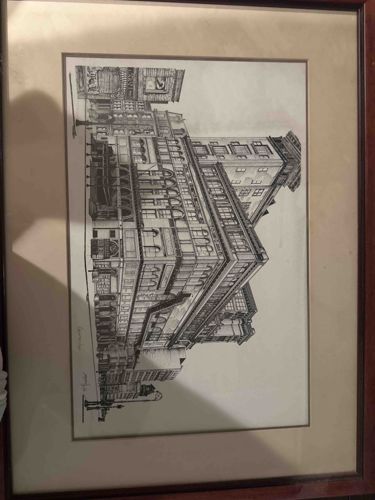
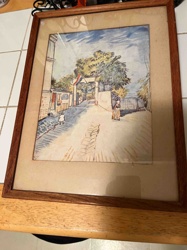
This item is a framed pen and ink architectural drawing, depicting a detailed street scene with multi-story buildings. The artwork is rendered entirely in black ink on a light-colored paper, possibly white or cream, exhibiting a high level of precision and intricate linework often associated with technical drafting or architectural illustration. The buildings feature numerous windows, ornate cornices, decorative facades, and visible architectural elements such as fire escapes, water tanks on rooftops, and what appears to be signage on some structures. The perspective suggests a street-level view looking up at a dense urban environment. The drawing is housed in a traditional wooden frame, likely made of stained hardwood, with a warm, reddish-brown tone. A neutral-colored mat board, appearing to be a light beige or off-white, surrounds the artwork, providing a visual border and separation from the frame. The visibility of the glass covering the artwork is evident from reflections and the slight shadow it casts. There are no immediately apparent condition issues on the artwork itself, such as tears, smudges, or significant discoloration. However, the mat board shows some minor signs of age or handling, possibly some light foxing or subtle discoloration along its edges, particularly noticeable in the upper right. The frame also appears to be in good condition, with no overt damage or scratches visible. The precise detailing and clean lines indicate skilled craftsmanship. The overall style suggests an age perhaps from the mid-to-late 20th century, given its realistic, detailed representation and common framing styles of that era. A faint signature or inscription is visible in the lower left portion of the drawing, which could potentially identify the artist, though it is not clearly legible from the provided image.
AI Appraisal Report
Based on my visual examination of the provided image, this framed pen and ink architectural drawing is in good overall condition. The artwork itself appears free from significant flaws such as tears, smudges, or discoloration. The precision and intricate linework are hallmarks of skilled draftsmanship. The mat board shows minor signs of age, potentially light foxing or subtle discoloration, particularly in the upper right. The wooden frame is in good condition with no visible damage. This piece appears authentic as a genuine pen and ink drawing from the mid-to-late 20th century. The style is common for urban architectural renderings of that period.
Market conditions for detailed architectural drawings of this nature can vary. While general pen and ink works have a steady market, those by unidentified artists typically command more modest prices. Comparables for unsigned or lightly signed urban architectural drawings of good quality generally fall within the $200-$500 range, depending on size, intricacy, and specific aesthetic appeal. Demand is moderate, appealing to collectors of architectural art, local history enthusiasts, or those seeking decorative urban landscapes. Rarity is not a significant factor here without artist identification.
The primary factor impacting value positively is the intricate detail and clean execution. The lack of a clearly legible signature and thus definitive artist attribution limits its upper market potential significantly. Without clear provenance, it's considered a decorative piece rather than a collectible by a known artist.
It is crucial to note that this assessment is based solely on visual examination of the provided image. For full authentication and a more definitive appraisal, an in-person examination would be necessary to verify the medium, paper quality, any watermarks, and to fully decipher the signature/inscription. Examination under UV light could help detect repairs or alterations. Provenance documentation, such as artist's records or previous sales receipts, would also be invaluable for establishing authenticity and artist attribution.