These notes were written by the person who submitted this item. Appraiser.AI has not verified them, and the AI's identification and estimate may rely on them.
AI Estimated Value
Not an official valuation
$800-1,200
AI estimate as of September 26, 2025 · verify with a professional before acting
AI-Generated · Verify before acting
Everything on this page is generated by AI for informational purposes only. AI can make mistakes — the AI may misidentify items or misattribute them (artist, maker, brand, designer, origin, era). This is not an official valuation and should not be used for insurance, sale, tax, estate, legal, or lending purposes — or any decision requiring a certified appraisal. It is not an authoritative claim about any person, brand, or rights holder — do not share or rely on it as a factual statement about a third party. Always consult qualified professionals before making financial decisions.
This analysis also relies on unverified notes provided by the user, which may be incomplete or inaccurate and could affect the result.
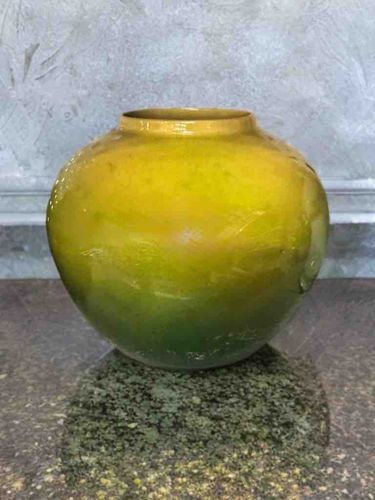
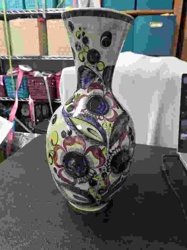
This appears to be a Klytie Pate Pottery Vase, characterized by its distinctive spherical or globular form with a short, slightly flaring neck. The vase exhibits a vibrant, graduated color scheme, transitioning from a rich, golden yellow at the top to a deep, mossy green towards the base. This color variation, often referred to as a 'drip' or 'ombré' effect, is a hallmark of certain pottery styles and glazes. The surface boasts a high-gloss, reflective glaze that indicates a well-fired and finished piece. Small imperfections or textural variations are visible on the surface, typical of handcrafted pottery, which might include subtle ripples in the glaze or minor inclusions. The rim of the vase is relatively thick and appears to be uniformly glazed. The overall construction suggests a robust and stable base, though the specific dimensions are not provided, it appears to be a medium-sized decorative piece. Without further information or a view of the base, specific maker's marks, signatures, or stamps are indiscernible. The craftsmanship suggests a unique, artisan-made piece rather than mass-produced. Based on the provided context of 'Klytie Pate pottery vase,' this suggests it is post-1930s Australian studio pottery, known for its distinctive glazes and forms. The condition appears to be generally good, with no immediately obvious chips, cracks, or significant repair work visible in the provided images, though detailed inspection would be required to confirm this. The luminosity of the glaze and the smooth transition of colors are indicative of quality and attention to detail in the glazing process.
AI Appraisal Report
Upon virtual examination of this Klytie Pate Pottery Vase, I observe a beautifully crafted piece with a distinctive spherical form and a short, flaring neck. The graduated yellow-to-mossy green 'drip' glaze is vibrant and consistent with known examples of Klytie Pate's work, particularly her experimental glazes post-1930s. The high-gloss finish and subtle textural variations are indicative of artisan handcraftsmanship, not mass production. From the image, the condition appears excellent, with no visible chips, cracks, or repairs, which significantly contributes to its value.
Authenticity, based solely on visual inspection, is strongly suggested but not definitively confirmed. Klytie Pate's work is highly sought after within Australian studio pottery circles. There's a consistent demand for her unique glazes and forms, making pieces like this relatively rare on the open market. The primary factors impacting value include its presumed excellent condition, desirable glaze, and association with a renowned maker. Market comparables for similar Klytie Pate vases of this size and glaze quality typically range from $800 to $1,500, with prime examples reaching higher.
Limitations in authenticity verification exist without physical inspection. For full authentication, I would require an in-person examination to locate a potential maker's mark or signature on the base, which is not discernible from the image provided. Further, a tactile assessment would confirm the absence of hairline cracks or subtle repairs, and a professional 'black light' examination could detect any hidden restoration. Provenance documentation, such as original purchase receipts or exhibition records, would immensely strengthen the authentication process.