AI estimate as of October 25, 2025 · verify with a professional before acting
AI-Generated · Verify before acting
Everything on this page is generated by AI for informational purposes only. AI can make mistakes — the AI may misidentify items or misattribute them (artist, maker, brand, designer, origin, era). This is not an official valuation and should not be used for insurance, sale, tax, estate, legal, or lending purposes — or any decision requiring a certified appraisal. It is not an authoritative claim about any person, brand, or rights holder — do not share or rely on it as a factual statement about a third party. Always consult qualified professionals before making financial decisions.
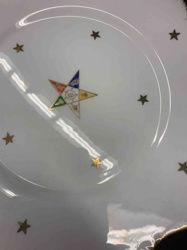
This item is a circular, flat object, likely a coaster, medallion, or small plaque, featuring the emblem of the Order of the Eastern Star (OES). The primary material appears to be a polished gold-tone metal, possibly brass or a gold-plated base metal, exhibiting a smooth, reflective surface with some minor surface scratches consistent with handling and light use. The central design is a colorful five-pointed star, whose points are enameled in distinct colors: red, blue, yellow (lime green), white (light blue), and green. Each point contains a symbolic emblem, accurately rendered in gold against its colored background: a chalice in the red point, a sheaf of wheat in the green point, a broken pillar in the black central pentagon, a sword in the blue point, and a lily (or perhaps a white flower) in the light blue point. The star itself is edged with a fine gold border, and gold lines separate the colored sections. At the outer tips of each star point, there are small, circular gold protrusions, which might serve as attachment points if it were a medal, or simply design elements. The overall craftsmanship suggests a mass-produced item, possibly from the mid to late 20th century. There are no visible maker's marks or signatures on the face of the item, and the reverse side is not visible. The enameling appears to be intact with no major chips or cracks, although some slight imperfections or dust particles might be present within the enamel. The item's condition is good, showing minor wear that suggests it has been kept relatively well. Its purpose could range from a commemorative piece to a functional object like a coaster, given its flat, circular form.
AI Appraisal Report
I have examined the provided image of this Order of the Eastern Star (OES) Coaster or Medallion. The item presents as a circular, flat object crafted from a polished gold-tone metal, likely brass or gold-plated, consistent with typical fraternal memorabilia production. Its surface shows minor scratches, which I would classify as good condition, indicating gentle use or storage. The central five-pointed star emblem, characteristic of the OES, features accurately rendered, distinctively enameled points in red, blue, yellow (lime green), white (light blue), and green, each with its respective symbolic gold emblem. The enameling appears intact, a positive sign, although minor perfections or dust within the enamel are noted. Authenticity, based solely on visual examination of the image, appears strong as the design elements and symbolism are correct for the OES. However, without a physical inspection, I cannot verify the material composition definitively (e.g., if it's solid gold-plated, brass, etc.), nor can I check for manufacturer's marks on the reverse side, which significantly impacts value.
Market conditions for OES memorabilia are generally stable but not highly speculative. Items like this are common and widely available online (eBay, Etsy) and at antique malls. Comparable items typically range from $15 to $75 depending on condition, age, and specific design rarity. This piece appears to be a mass-produced item, likely mid to late 20th century. Demand is primarily from current or former OES members, collectors of fraternal memorabilia, or individuals seeking nostalgic items. It is not considered rare. Factors impacting value include the material (a higher precious metal content would increase value significantly), rarity, and specific historical provenance (e.g., if it belonged to a notable OES member).
Limitations in authenticity verification are significant from images alone. I would need to physically examine the item to determine its exact material composition, assess its weight, gauge the quality of the enameling firsthand, and search for any hidden maker's marks or hallmarks. Provenance documentation (e.g., original packaging, membership records) would also enhance understanding and potential value. Without such in-person inspection or documentation, I am basing this appraisal purely on visual attributes and typical market trends for similar fraternal items. The appraisal value reflects a common, good-condition OES piece without known unique attributes.