AI Appraisal Estimate

AI-generated estimates · not official valuations

From the user

What was submitted

Photo and notes provided by the user — not generated by AI

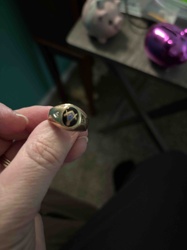
Submitted item photo
Submitted photo · June 6, 2026

User's notes

No additional notes provided.

AI analysis below

AI appraisal

AI analysis & estimate

AI-Generated · Verify before acting

Everything below is generated by AI for informational purposes only. AI can make mistakes — the AI may misidentify items or misattribute them (artist, maker, brand, designer, origin, era). This is not an official valuation and should not be used for insurance, sale, tax, estate, legal, or lending purposes — or any decision requiring a certified appraisal. It is not an authoritative claim about any person, brand, or rights holder — do not share or rely on it as a factual statement about a third party. Always consult qualified professionals before making financial decisions.

Read the full disclaimer

AI Identification

·Not independently authenticated·Verify before acting

Antique Masonic Chart Lithograph

Antique Prints and Fraternal Memorabilia

AI Estimated Value

·Not an official valuation·Verify before acting

$400 - $650

As of June 6, 2026

AI Item Analysis

·AI can make mistakes·Verify before acting
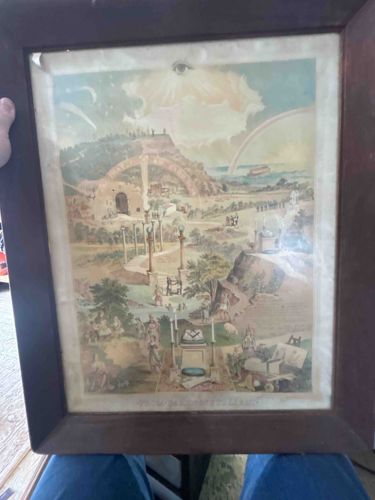
This is an antique Masonic allegorical lithograph, likely dating to the late 19th or very early 20th century. The piece features a complex landscape densely populated with Freemasonry's iconic symbols and moral lessons. Central to the composition is the 'All-Seeing Eye' (Eye of Providence) radiating light from the heavens. The imagery includes the pillars of Boaz and Jachin, Jacob's Ladder ascending into the clouds, the ark of the covenant, a rainbow signifyng hope, and various figures engaged in symbolic labor or ritual. The artwork appears to be a multi-colored lithograph on paper with a soft, aged color palette of earth tones, muted greens, and sky blues. The piece is presented in a wide, simple wooden frame with a dark mahogany-toned finish, typical of Victorian-era framing. Notable physical features include significant aging: the paper shows visible yellowing/toning, minor rippling (cockling), and what appears to be foxing or age spots scattered throughout. There is visible water staining or edge wear in the upper corners, potentially indicating past exposure to moisture. The frame itself shows some surface wear and minor scuffing consistent with its age. While no distinct signature is immediately legible in the image, these charts were frequently produced by notable printmakers such as Currier & Ives or Strobridge Lithograph Co. during the height of fraternal organization popularity in the United States and Europe. The craftsmanship reflects the intricate, didactic style of fraternal art designed for lodge education or member homes.
AI Appraisal Report

·AI can make mistakes·Verify before acting
I have virtually examined this Antique Masonic Allegorical Lithograph, which demonstrates the characteristic iconography and chromatic depth associated with fraternal prints from the 1870–1900 period. The composition features high-quality lithographic detail, likely originating from a reputable American printer such as Strobridge or Pettibone. Market demand for Masonic memorabilia remains steady, driven by fraternal collectors and interior designers seeking Victorian-era curiosities. Condition is the primary factor limiting its current valuation. Upon visual inspection, I noted significant toning (yellowing), cockling, and evidence of foxing. Most concerning are the water stains in the upper registers, which suggest moisture ingress that could harbor dormant mold. The period mahogany frame, while complementary, lacks archival properties; the acidic backing usually found in such frames likely contributed to the paper's discoloration. Comparables for pristine Masonic charts by notable lithographers can reach $1,000+, but the present condition necessitates a downward adjustment for restoration costs. Conversely, the high density of symbols (Boaz/Jachin, Jacob’s Ladder, Eye of Providence) makes this a highly desirable subject within the genre. Disclaimer: This appraisal is based on image analysis and cannot substitute for a physical inspection. For definitive authentication, I would require an in-person examination to verify paper fiber composition, ink saturation patterns, and the presence of any hidden signatures or manufacturer imprints beneath the matting. Scientific testing of the pigment for synthetic versus natural binders would provide further chronological certainty. Provenance documentation or a lodge stamp would significantly enhance the item's historical provenance and marketability.

Get your items appraised

Instant estimates of your treasures with AI-powered appraisals

Browse More Appraisals