AI estimate as of October 25, 2025 · verify with a professional before acting
AI-Generated · Verify before acting
Everything on this page is generated by AI for informational purposes only. AI can make mistakes — the AI may misidentify items or misattribute them (artist, maker, brand, designer, origin, era). This is not an official valuation and should not be used for insurance, sale, tax, estate, legal, or lending purposes — or any decision requiring a certified appraisal. It is not an authoritative claim about any person, brand, or rights holder — do not share or rely on it as a factual statement about a third party. Always consult qualified professionals before making financial decisions.
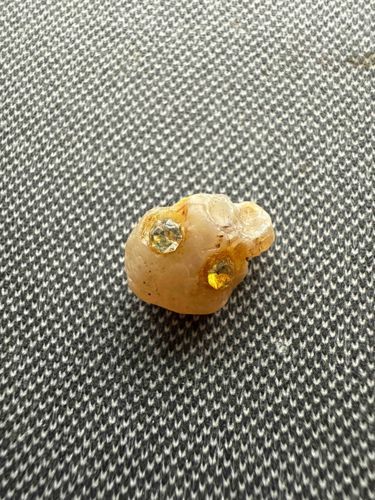
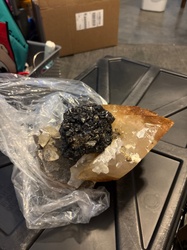
This item is a small, irregularly shaped boulder opal specimen, likely unpolished and in its natural or raw state. The dominant color of the host rock, which appears to be ironstone or sandstone, is a light, earthy brown or pale peach. It exhibits a somewhat rough, natural texture with some visible pitting and inclusions on its surface that are characteristic of unworked stone. Embedded within this matrix are several small patches of iridescent opal, displaying a vibrant play of color. Specifically, there are at least two distinct areas where the opal flashes with golden-yellow and possibly green hues when light reflects off its surface. One larger patch is visible towards the top-left, and a smaller, more intensely golden patch is visible towards the bottom-right of the specimen. The size appears to be quite small, likely fitting comfortably within a fingertip, suggesting it might be suitable for a small pendant, an inlay project, or kept as a collector's specimen. There are no visible maker's marks, signatures, or stamps, which is typical for a raw mineral specimen. The condition appears to be good for a natural specimen, with no obvious signs of recent damage or repair, although the inherent rough nature means it possesses natural fissures and irregularities. The specimen’s style is distinctly natural, reflecting geological processes rather than human artistry, and its age is geological. The quality of the opal's play of color in the visible patches is a key indicator of its potential value.
AI Appraisal Report
I have examined the provided image of this small boulder opal specimen. It presents as an irregularly shaped piece of host rock, likely ironstone or sandstone, with a light brown/pale peach hue, characteristic of natural, unpolished material. The surface exhibits typical roughness, pitting, and inclusions for a raw stone. Authenticity, based on visual cues alone, appears strong for a natural boulder opal given the distinctive matrix and embedded opal patches. The key value drivers are the two visible patches of iridescent opal displaying golden-yellow and possibly green play of color. The smaller patch at the bottom-right appears more intense in its flash. Given its small size, likely fingertip-sized, it is best suited for collection, small inlay work, or a modest pendant. The condition is good for a natural specimen; inherent fissures and irregularities are expected and do not detract from its raw state.
In terms of market conditions, small raw boulder opal specimens with visible play of color typically command modest prices. Comparables in the online market for similar small, unpolished specimens range from $20 to $100, depending heavily on the intensity and coverage of the opal flash. Demand for small collector specimens is consistent, driven by hobbyists and jewelry makers seeking unique materials. While opal itself is not rare, high-quality boulder opal with significant play of color is more uncommon. The limited extent of the visible opal flashes and the small overall size are factors that cap its value.
It is crucial to note the limitations of image-based appraisal. I cannot assess the depth, stability, or full spectrum of the opal’s play of color without physical examination. Factors like crazing (cracking) or hidden inclusions, which could impact durability and value, are not discernible from photos. Furthermore, the exact type of host rock (e.g., ironstone vs. sandstone) can be better confirmed in person. Therefore, while I believe this specimen to be authentic and estimate its value, a conclusive authentication and precise valuation would require in-person inspection, and potentially refractometry or specific gravity tests in rare cases of doubt.