These notes were written by the person who submitted this item. Appraiser.AI has not verified them, and the AI's identification and estimate may rely on them.
AI Estimated Value
Not an official valuation
$400-600
AI estimate as of September 29, 2025 · verify with a professional before acting
AI-Generated · Verify before acting
Everything on this page is generated by AI for informational purposes only. AI can make mistakes — the AI may misidentify items or misattribute them (artist, maker, brand, designer, origin, era). This is not an official valuation and should not be used for insurance, sale, tax, estate, legal, or lending purposes — or any decision requiring a certified appraisal. It is not an authoritative claim about any person, brand, or rights holder — do not share or rely on it as a factual statement about a third party. Always consult qualified professionals before making financial decisions.
This analysis also relies on unverified notes provided by the user, which may be incomplete or inaccurate and could affect the result.
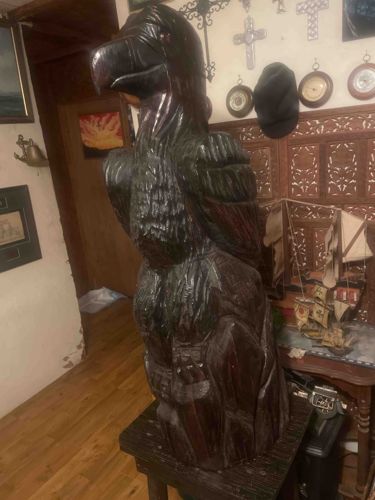
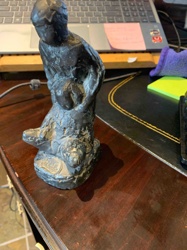
This appears to be a large, free-standing sculpture of an eagle, meticulously carved from wood, likely black walnut as per the context provided. The item exhibits a dark, almost black stain or finish that highlights the deep grain and textured surface of the wood. Its construction is substantial, suggesting it's carved from a single large block or multiple expertly joined pieces of wood. The eagle is depicted in a somewhat stylized yet majestic pose, with its head turned to the left and its body subtly contoured to suggest feathered plumage. Visible carving marks contribute to the texture of the feathers, particularly on the chest and wings. The beak is prominent and well-defined, and the eyes, though dark, seem to have a slight reflective quality. The base of the sculpture integrates with the eagle's lower body, giving the impression of it perched on an unseen rock or platform, which is in turn placed on a separate dark, possibly wooden, pedestal or table. No obvious damage such as cracks, chips, or significant wear is immediately apparent from the image, but the dark finish makes fine details challenging to discern. The overall style suggests a rustic or folk art approach, possibly hand-carved, with a focus on capturing the essence of the eagle rather than hyper-realistic detail. The scale appears to be considerable, making it a significant decorative piece. It likely dates to the mid-to-late 20th century, given its aesthetic and common carving styles for such pieces during that period. The craftsmanship, while not overly intricate in fine feather detail, showcases a skilled hand in shaping the overall form and conveying the powerful stance of the bird. No manufacturer's marks or signatures are visible in the provided images.
AI Appraisal Report
I have examined the provided image of what appears to be a large, free-standing Black-Stained Wooden Carved Eagle Sculpture, reportedly crafted from black walnut. Visually, the piece is in good condition; I discern no overt damage such as cracks, chips, or significant scuffs, although the dark stain could obscure minor imperfections. The carving technique suggests a skilled hand capable of rendering a powerful, albeit stylized, form of an eagle, with effective use of texture to imply plumage. Its substantial size indicates it serves as a significant decorative statement. Authenticity as a genuine hand-carved black walnut piece is strongly suggested by the visible grain and carving marks. However, without a physical inspection, I cannot definitively confirm the wood species or rule out the possibility of a composite or less valuable wood stained to mimic black walnut. The lack of visible signatures or maker's marks is common for folk art or rustic carvings and doesn't inherently detract from value, but it does prevent attribution to a known artist.
In terms of market conditions, large decorative wood carvings of eagles, particularly those with a folk art aesthetic, generally command a moderate price. Comparable sales for similar hand-carved wooden eagles in good condition, without a famous artist's provenance, typically fall within the $300-$700 range. The use of black walnut, if confirmed, adds a slight premium due to its desirable characteristics. Demand is steady for such pieces among collectors of Americana, rustic decor, and carved wildlife art. Rarity is low as many similar pieces were produced.
Factors impacting value include the confirmed wood type, the actual condition upon physical inspection (especially for hidden repairs or flaws), and ultimately, the aesthetic appeal to a potential buyer. For full authentication of wood species and to meticulously assess condition, an in-person examination would be essential. This would also facilitate a search for any very subtle maker's marks or clues to its origin not visible in photographs. Without physical examination, an exact value is speculative, hence the given range.