AI estimate as of September 17, 2025 · verify with a professional before acting
AI-Generated · Verify before acting
Everything on this page is generated by AI for informational purposes only. AI can make mistakes — the AI may misidentify items or misattribute them (artist, maker, brand, designer, origin, era). This is not an official valuation and should not be used for insurance, sale, tax, estate, legal, or lending purposes — or any decision requiring a certified appraisal. It is not an authoritative claim about any person, brand, or rights holder — do not share or rely on it as a factual statement about a third party. Always consult qualified professionals before making financial decisions.
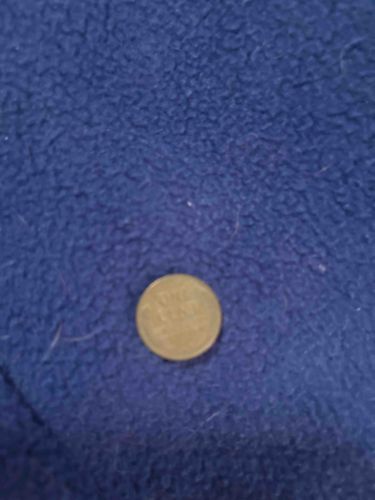
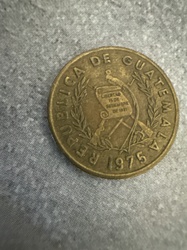
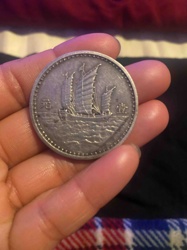
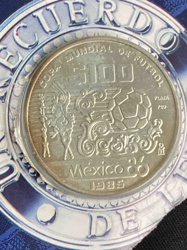
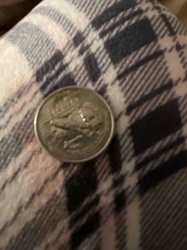
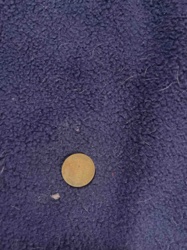
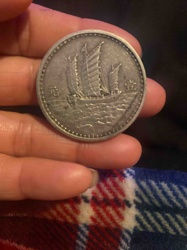
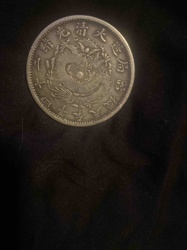
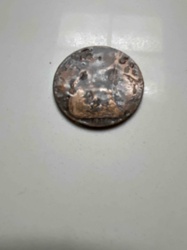
The item appears to be a single, circular coin, likely made of a copper or bronze alloy due to its reddish-brown color and visible patina. The overall hue suggests it is not made of silver or a shiny, contemporary metal. Based on the discernible, albeit blurry, text which seems to read "ONE CENT", it is likely a low-denomination currency. The coin is relatively small and thin, consistent with standard coinage. Its surface shows signs of significant wear, including blurring of the details and a general dullness, indicating it has been in circulation for an extended period or subjected to environmental degradation. There are no clear markings or dates immediately visible from the provided image, making precise identification of its country of origin or year of minting impossible without further examination. The edges of the coin appear somewhat smooth and rounded by wear. The visible condition suggests a circulated grade with a moderate to heavy patina, which could be natural aging or a result of handling. No obvious damage such as deep scratches, bends, or holes are apparent, but the low resolution prevents a definitive assessment of minor flaws. Its style appears utilitarian, typical of currency. Without clearer images of both obverse and reverse, and any mint marks or dates, specific historical context or unique features are speculative.
AI Appraisal Report
Upon examining the provided image of this 'Unidentified' coin, I assess its condition as 'Good' to 'Very Good' (G-VG) on the Sheldon scale, indicative of significant wear. The reddish-brown coloration and visible patina suggest a copper or bronze composition. The discernible, albeit blurry, text 'ONE CENT' strongly implies it's a low-denomination currency, likely a U.S. Large Cent or a similar coin from another nation. Authenticity, based solely on this image, cannot be definitively confirmed; however, its apparent age and wear patterns do not immediately suggest a modern counterfeit. Given the general lack of distinct features, visible dates, or mint marks, uniqueness or rarity is impossible to ascertain from this single image.
Market conditions for extremely worn, unidentified copper/bronze cents are generally low. Comparables would include 'junk box' or 'common date' Large Cents, Indian Head Cents, or similar world coins in G-VG condition. Demand for such items is typically driven by novice collectors filling type sets or individuals seeking affordable historical artifacts. Without clear identifying features, demand is minimal among advanced collectors.
Factors significantly impacting value are the inability to identify the coin's precise origin, date, and denomination beyond 'one cent.' If a clear date or an identifying feature (such as a unique mint mark or a rare variety) were visible, the value could increase dramatically. As it stands, limited detail heavily restricts its numismatic appeal.
For full authentication and a more precise valuation, an in-person examination is crucial. This would allow for a proper assessment of surface details, edges, weight, diameter, and composition. Magnification would be required to search for faint dates, mint marks, or other identifying characteristics. Provenance documentation, while unlikely for such a common-looking item, would further aid in historical context. Scientific testing for composition is not typically warranted for a coin in this condition unless an unusual alloy is suspected.