AI estimate as of June 27, 2025 · verify with a professional before acting
AI-Generated · Verify before acting
Everything on this page is generated by AI for informational purposes only. AI can make mistakes — the AI may misidentify items or misattribute them (artist, maker, brand, designer, origin, era). This is not an official valuation and should not be used for insurance, sale, tax, estate, legal, or lending purposes — or any decision requiring a certified appraisal. It is not an authoritative claim about any person, brand, or rights holder — do not share or rely on it as a factual statement about a third party. Always consult qualified professionals before making financial decisions.
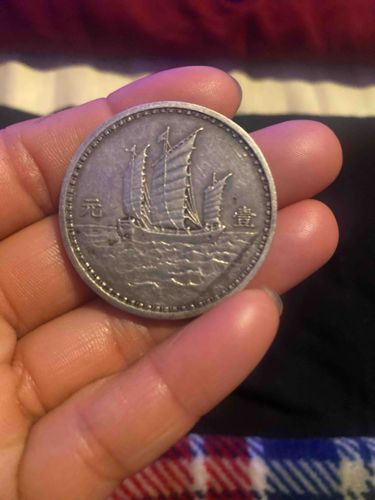
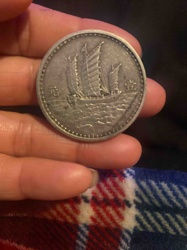
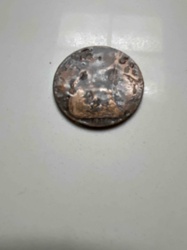
This circular metallic coin, appearing to be composed primarily of silver due to its characteristic luster and toning, measures approximately the size of a standard circulating coin, held comfortably in an adult's hand as shown. The visible side, likely the obverse, features a prominent and detailed Chinese junk ship, a traditional multi-masted sailing vessel, navigating across a choppy sea, indicated by well-defined waves. The ship is rendered with visible rigging lines and segmented sails, suggesting a realistic portrayal. Alongside the ship, Chinese characters are strategically placed: "元" (Yuan) to the left and "壹" (One) to the right, clearly denoting its denomination as "One Yuan". The entire central design is encircled by a raised, dotted border, which adds a decorative element and protects the central motif from edge wear.
In terms of condition, the coin exhibits clear signs of considerable circulation and age. There is a noticeable dark greyish-black patina, particularly accumulating in the recessed areas of the design, which is a common characteristic of aged silver and contributes to its authentic antique appearance. While the primary details of the junk ship and the Chinese characters remain distinct, there is a general softening of the finer lines and reduced relief, consistent with wear across the higher points of the design such as the sails and the ship's hull due to prolonged handling. No severe dents, deep scratches, or significant edge damage are readily apparent from this view, though minor surface abrasions consistent with general circulation and storage over time are present. The craftsmanship reflects national coinage production standards of its era, balancing symbolic imagery with practical durability. This specific design is iconic for the 'Junk Dollar' series issued during the Republic of China period, placing its estimated age in the early 1930s (e.g., 1932, 1933, 1934). The reverse side, typically featuring a portrait or national emblem, is not visible in the provided image.
AI Appraisal Report
Upon visual examination of the provided image, this Republic of China 'Junk Dollar' One Yuan Silver Coin appears authentic based on its distinctive design elements, characteristic wear patterns, and the natural appearance of the dark silver patina. The artistic rendition of the junk ship and legible Chinese characters are consistent with known examples from the early 1930s (likely 1932, 1933, or 1934). I assess its condition to be approximately in the Fine (F) to Very Fine (VF) range. While the primary details are clear, there is noticeable softening of finer lines and reduced relief on high points, indicative of significant circulation.
'Junk Dollars' are highly collectible worldwide, especially in Asian numismatic markets, ensuring consistent demand. While not inherently rare in circulated grades, original examples are always sought after due to their iconic status and historical significance. The natural, undisturbed patina enhances its appeal, suggesting it has not been aggressively cleaned, a factor that would significantly diminish its value. Its popular type and apparent good preservation of main design elements contribute positively to its marketability.
However, it is imperative to note that a definitive authenticity verification and precise grading cannot be achieved from images alone. The market for these coins includes high-quality counterfeits. For full authentication and accurate grading, an in-person examination is crucial. This would involve precise measurements (weight, diameter, thickness), edge analysis, specific gravity or XRF testing for metallic composition, and microscopic analysis to confirm strike characteristics and rule out modern fabrication. Provenance documentation, if available, would further solidify its value.