AI estimate as of December 1, 2025 · verify with a professional before acting
AI-Generated · Verify before acting
Everything on this page is generated by AI for informational purposes only. AI can make mistakes — the AI may misidentify items or misattribute them (artist, maker, brand, designer, origin, era). This is not an official valuation and should not be used for insurance, sale, tax, estate, legal, or lending purposes — or any decision requiring a certified appraisal. It is not an authoritative claim about any person, brand, or rights holder — do not share or rely on it as a factual statement about a third party. Always consult qualified professionals before making financial decisions.
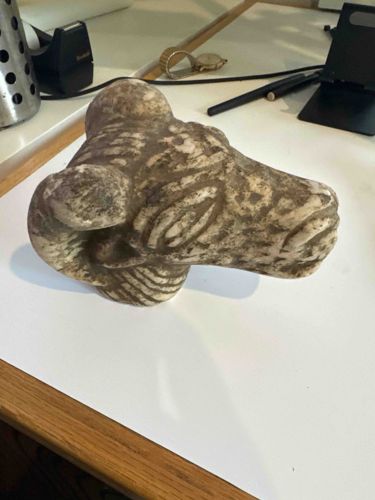
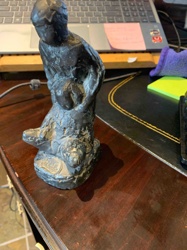
The item is a carved sculpture depicting the head and upper torso of an animal, possibly a feline or canid, with a stylized mane or fur texture. It appears to be made from a dense, light-colored stone, possibly limestone or a similar material, which has developed a notable patination over time. The coloration is predominantly a mottled off-white or light beige, heavily interspersed with darker brown and greyish-brown tones, giving it an aged and weathered appearance. The carving displays pronounced, deep grooves and ridges, especially evident in the fur-like textures around the neck and head, suggesting a robust, perhaps somewhat primitive or ancient carving style. Key features include a prominent snout, defined brow ridges, and what appears to be a thick mane or collar around the neck. The eyes are not explicitly detailed but are indicated by carved depressions. The overall form is substantial and heavy, typical of stone sculptures. There are no clear identifying marks, signatures, or stamps visible in the provided image. The rough texture and weathered look suggest either considerable age or an intentional antique finish. The condition appears consistent with age and exposure, featuring a natural patina, but no obvious chips, cracks, or repairs are immediately discernible from this perspective. The craftsmanship, while not highly refined in terms of smooth finish, shows a confident hand in capturing the animal's powerful form. Its style hints at an ancient or tribal art aesthetic, though without further context or scale, a precise period or origin is difficult to pinpoint. The base of the neck appears to be deliberately flattened or cut, indicating it might have been part of a larger structure, a decorative architectural element, or intended for display on a flat surface.
AI Appraisal Report
I have carefully examined the provided image of the carved stone animal head sculpture. Visually, the piece presents as a substantial work, likely crafted from limestone or a similar light-colored, dense stone. Its mottled off-white, brown, and greyish-brown patination strongly suggests significant age or an intentional antique finish. The deep grooves and ridges, especially evident in the stylized mane/fur around the head and neck, indicate a robust carving technique, possibly pointing to an ancient or tribal art aesthetic.
Condition appears stable, consistent with age and exposure, showing natural wear and patination. I don't observe any overt chips, cracks, or repairs from this photographic angle, which is a positive. The craftsmanship, while not high-polish refined, demonstrates a confident hand in capturing a powerful animal form. The flattened base suggests it was intended for display or as part of a larger structure.
Authenticity is the primary challenge when appraising from images alone. While the aesthetic cues – patination, carving style, and apparent age – are compelling, precise dating or origin cannot be confirmed without in-person examination. Modern reproductions or 'antiqued' pieces can mimic these characteristics effectively. Market conditions for genuine ancient or ethnographic stone carvings are strong, with demand for unique, characterful pieces. Rarity would depend entirely on its true provenance. If genuinely ancient or tribal, its value would be significantly higher. Without provenance, its decorative appeal largely drives its market as a compelling antique-style object.
Factors impacting value: The aesthetic appeal is high. The lack of identifying marks limits definitive attribution. For full authentication and a more precise valuation, an in-person examination by a stone conservation expert is crucial to assess tool marks, stone composition, and patination veracity. Scientific dating (e.g., thermoluminescence, if applicable) and thorough provenance documentation would be essential to verify age and origin. Based solely on its decorative merit and perceived age from the image, I estimate its value to be in the range of $600-$1,200.