These notes were written by the person who submitted this item. Appraiser.AI has not verified them, and the AI's identification and estimate may rely on them.
AI Estimated Value
Not an official valuation
$30-60
AI estimate as of November 2, 2025 · verify with a professional before acting
AI-Generated · Verify before acting
Everything on this page is generated by AI for informational purposes only. AI can make mistakes — the AI may misidentify items or misattribute them (artist, maker, brand, designer, origin, era). This is not an official valuation and should not be used for insurance, sale, tax, estate, legal, or lending purposes — or any decision requiring a certified appraisal. It is not an authoritative claim about any person, brand, or rights holder — do not share or rely on it as a factual statement about a third party. Always consult qualified professionals before making financial decisions.
This analysis also relies on unverified notes provided by the user, which may be incomplete or inaccurate and could affect the result.
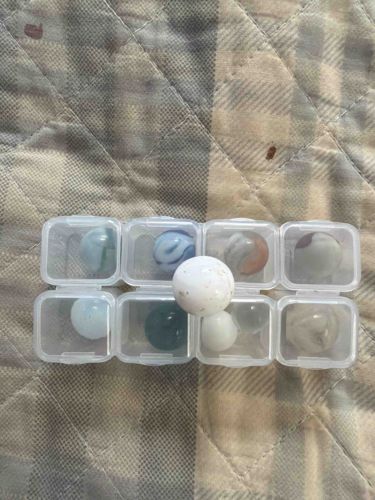
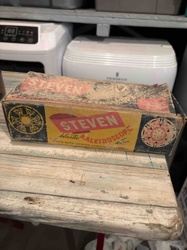
This collection features a variety of vintage glass marbles, collectively housed in a clear plastic storage case. The case consists of eight individual compartments, with seven of these compartments each containing a single marble, and one compartment holding two smaller marbles. The marbles display a range of colors and patterns, indicative of various manufacturing techniques. Notable examples include a white marble with small, scattered flecks, which appears to be a larger 'shooter' type, lying outside its compartment but positioned centrally amongst the top and bottom rows of compartments. Inside the compartments, there are marbles with swirled patterns (possibly traditional 'swirls'), solid colored marbles (a dark teal/green, a light blue), and others with less distinct internal coloration or clear glass properties. Sizes vary, with the central white speckled marble being the largest, and two smaller, smooth white/off-white marbles visible in one compartment. The marbles generally exhibit a glossy finish, typical of glass, but without close inspection, it's difficult to determine the presence of 'moonies' (surface imperfections), 'fleabites' (tiny nicks), or other forms of play wear such as pitting or bruising. The age is estimated as vintage, potentially mid-20th century, given the common styles and materials associated with marble production during that period. The plastic storage case itself is functional but basic, suggesting a utilitarian purpose for organization rather than artistic display, and does not appear to be an original or 'factory' packaging for these specific marbles. The overall craftsmanship of the marbles cannot be fully assessed without more detailed images, but the visible patterns suggest standard glass marble manufacturing.
AI Appraisal Report
I've examined the provided image of this collection of assorted vintage glass marbles housed in a clear plastic storage case. The collection comprises various styles, including swirled patterns, solid colors, and a larger white speckled 'shooter' type. Based on my visual assessment, the marbles appear to be in generally good vintage condition with a glossy finish. Without a physical inspection, however, I cannot definitively assess for 'moonies,' 'fleabites,' or other wear like pitting or bruising that are common with play-worn marbles and significantly impact value. The plastic case is functional but does not appear original to the marbles and adds minimal value beyond organization.
Authenticity is difficult to ascertain entirely from images alone. While the styles suggest mid-20th century vintage, identifying specific manufacturers (e.g., Akro Agate, Peltier Glass, Marble King) or rare patterns would require in-hand examination. Key factors impacting value include the manufacturer, pattern rarity, condition (especially absence of damage), and size. Currently, the market for common vintage marbles in good condition is moderate; truly rare or pristine examples command higher prices. This lot appears to be a good starter collection rather than a high-end rarity. To fully authenticate and assess condition, a physical examination under magnification is crucial, along with a thorough provenance review if available. Without this, the appraisal remains an estimate based on visual evidence of common vintage types.