AI estimate as of July 12, 2025 · verify with a professional before acting
AI-Generated · Verify before acting
Everything on this page is generated by AI for informational purposes only. AI can make mistakes — the AI may misidentify items or misattribute them (artist, maker, brand, designer, origin, era). This is not an official valuation and should not be used for insurance, sale, tax, estate, legal, or lending purposes — or any decision requiring a certified appraisal. It is not an authoritative claim about any person, brand, or rights holder — do not share or rely on it as a factual statement about a third party. Always consult qualified professionals before making financial decisions.
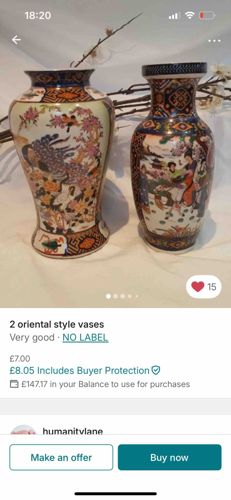
This lot consists of two 'oriental style' vases, likely ceramic or porcelain, exhibiting a rich and intricate polychrome enamel decoration. Both vases feature a similar color palette dominated by blues, oranges, greens, yellows, and browns, with significant gold accents used for outlining and detailing. The vase on the left is broader at the shoulder and tapers towards the base, which flares out slightly. Its primary decoration appears to be a large, elaborately plumed bird, possibly a peacock or phoenix, surrounded by floral motifs. There are also smaller human figures interspersed within the design. The neck and foot of this vase are adorned with geometric patterns, including a wave-like or scale pattern on the rim and intricate scrolled designs at the base. The second vase, on the right, has a more cylindrical body with a flared neck and a prominent base. Its decoration primarily depicts figural scenes, likely of court life or traditional narratives, with multiple human figures in various poses and attire, set against a background of foliage and architectural elements. The neck and base also feature detailed geometric patterns, similar in style to the other vase but with variations in design. Both vases display a glossy finish, indicative of a glazed surface. There are no obvious signs of significant damage such as chips or cracks visible in the provided image, and the enamel appears to be largely intact. The overall condition can be described as good to very good. Given the 'oriental style' description, these vases are likely reproductions or inspired by traditional Chinese or Japanese porcelain, possibly from the 20th century. The craftsmanship appears to be of a reasonable standard for decorative pieces, with detailed brushwork and a good application of glaze and enamels. No specific maker's marks or signatures are discernible from the image.
AI Appraisal Report
I have examined the provided image of this pair of 'Oriental Style' polychrome enamel vases. Visually, both vases appear to be in good to very good condition; I detect no apparent chips, cracks, or significant losses to the enamel. The glossy finish suggests a well-preserved glazed surface. Given the 'oriental style' nomenclature, it is highly probable these are decorative pieces inspired by traditional Chinese or Japanese porcelain, most likely produced in the 20th century. The intricate polychrome enamel decoration, with detailed figural scenes, floral motifs, and geometric patterns, indicates a reasonable level of craftsmanship for decorative wares. The extensive use of gold accents enhances their visual appeal.
From an authenticity standpoint, without physical inspection, provenance documentation, or scientific testing, I cannot definitively determine their precise origin, age, or maker. In-person examination would allow for a tactile assessment of the porcelain body, inspection of the underside for maker's marks or period-specific glaze characteristics, and a closer look at the enamel application quality which can reveal age and origin. While they are decorative and pleasing, they do not exhibit characteristics that strongly suggest a rare or historically significant antique status. The market for general 'oriental style' decorative ceramics is stable but not experiencing high demand for non-attributed, non-antique pieces. Comparables would include similar 20th-century decorative export wares. Their value is primarily driven by their decorative appeal, good condition, and the pair's cohesive presentation.