AI Appraisal Estimate

AI-generated estimates · not official valuations

From the user

What was submitted

Photo and notes provided by the user — not generated by AI

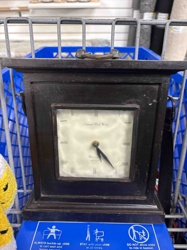
Submitted item photo
Submitted photo · May 16, 2026

User's notes

No additional notes provided.

AI analysis below

AI appraisal

AI analysis & estimate

AI-Generated · Verify before acting

Everything below is generated by AI for informational purposes only. AI can make mistakes — the AI may misidentify items or misattribute them (artist, maker, brand, designer, origin, era). This is not an official valuation and should not be used for insurance, sale, tax, estate, legal, or lending purposes — or any decision requiring a certified appraisal. It is not an authoritative claim about any person, brand, or rights holder — do not share or rely on it as a factual statement about a third party. Always consult qualified professionals before making financial decisions.

Read the full disclaimer

AI Identification

·Not independently authenticated·Verify before acting

Victorian Ebonized Mantle Clock

Clock

AI Estimated Value

·Not an official valuation·Verify before acting

$200-400

As of May 16, 2026

AI Item Analysis

·AI can make mistakes·Verify before acting
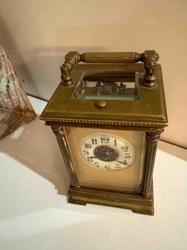
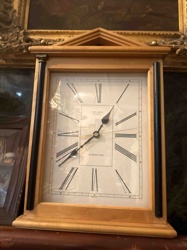
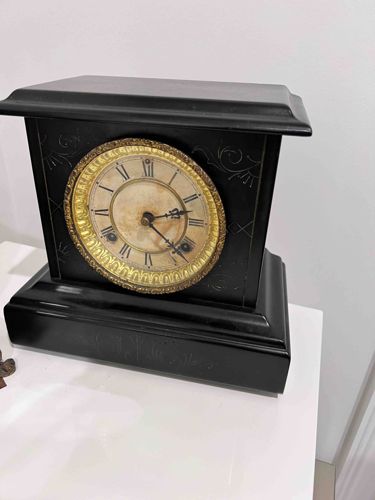
This is a vintage or antique mantle clock, likely from the Victorian era, presenting an ebonized finish on what appears to be a wooden case. The case has a rectangular, architectural form with a stepped base and a slightly overhanging plinth top. The dominant color is a matte black, suggesting an ebonized treatment. The front of the clock case features subtle, dark relief or engraved decorative elements, possibly in a scrolling or floral motif, on either side of the circular clock face. The clock face itself is circular, with Roman numerals for hours (I-XII) and what appear to be ornate, possibly blued steel, hour and minute hands. The face exhibits a noticeable aged patina, with a creamy, possibly discolored background. Surrounding the dial is a richly detailed, ornate brass or gilt metal bezel or frame, featuring a repetitive, possibly beaded or gadrooned pattern. The brass shows some tarnish and age consistent with its potential vintage. The overall condition appears good for its age, though some slight surface scratches or wear are visible on the ebonized base and top, which is typical for an item of this type and age. No specific maker's marks or signatures are discernible from the provided image. The craftsmanship suggests a manufactured piece of moderate quality from its period, designed for decorative and functional use in a domestic setting.

AI Appraisal Report

·AI can make mistakes·Verify before acting
This Victorian Ebonized Mantle Clock, as observed from the provided image, appears to be in good condition for its age. The ebonized finish shows typical wear, including minor scratches, which is consistent with a piece from the Victorian era. The ornate gilt bezel and Roman numeral dial suggest authenticity as a period piece, though the overall design seems to be of moderate quality rather than high-end craftsmanship. Without clear maker's marks, definitive attribution is challenging. Market conditions for mantle clocks vary. While antique clocks have a steady collector base, demand is not as robust as for other antique categories. Ebonized pieces are generally desirable. Comparables for similar Victorian ebonized mantle clocks without significant provenance or high-quality movements typically range from $200 to $500. Factors impacting value include the lack of visible damage, the intact functionality (though not tested), and decorative appeal. Several limitations exist from image-based appraisal. Authenticity of the ebonized treatment cannot be fully verified without physical inspection to discern if it's original or a later finish. The clock's movement, including its manufacturer, condition, and whether it's original to the case, is crucial for an accurate appraisal and cannot be assessed from images. Furthermore, the exact material of the decorative elements and potential repairs are unclear. An in-person examination would be required to verify the movement's functionality, assess any professional repairs, and search for hidden maker's marks. Provenance documentation, if available, would significantly enhance value and authenticity.

Get your items appraised

Instant estimates of your treasures with AI-powered appraisals

Browse More Appraisals