These notes were written by the person who submitted this item. Appraiser.AI has not verified them, and the AI's identification and estimate may rely on them.
AI Estimated Value
Not an official valuation
$75-125
AI estimate as of June 24, 2025 · verify with a professional before acting
AI-Generated · Verify before acting
Everything on this page is generated by AI for informational purposes only. AI can make mistakes — the AI may misidentify items or misattribute them (artist, maker, brand, designer, origin, era). This is not an official valuation and should not be used for insurance, sale, tax, estate, legal, or lending purposes — or any decision requiring a certified appraisal. It is not an authoritative claim about any person, brand, or rights holder — do not share or rely on it as a factual statement about a third party. Always consult qualified professionals before making financial decisions.
This analysis also relies on unverified notes provided by the user, which may be incomplete or inaccurate and could affect the result.
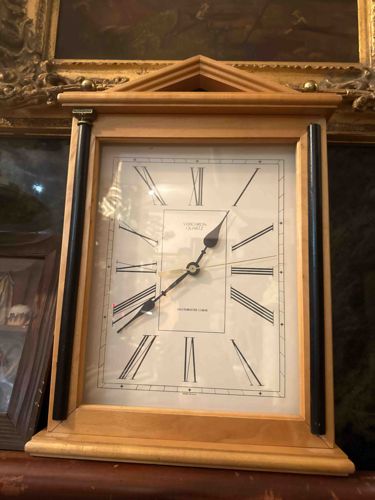
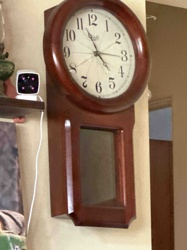
The item is identified as a Verichron Westminster Chime Mantel Clock. It features a light-colored wooden casing, likely pine or a similar light-grained wood, with a smooth, possibly varnished finish. The overall form of the casing suggests a classical or traditional aesthetic, evidenced by the pediment-style top with a triangular apex and a small, round finial on the top right. The front face of the clock is largely taken up by the clock dial, which is white with prominent black Roman numerals for hour markers and black minute markers. The hands are black, with a decorative, spade-like shape for the hour hand and a slender, pointed minute hand. A notable feature is the presence of two black, fluted or reeded columns on either side of the clock face, terminating in what appears to be brass or gold-toned caps, adding a touch of elegance and visual weight. The words "VERICHRON QUARTZ" are printed prominently below the 12 o'clock position, indicating the manufacturer and movement type. Below the center of the dial, "WESTMINSTER CHIME" is printed, signifying its chiming capability. The clock appears to be in good overall condition with no obvious signs of significant damage like cracks, chips, or deep scratches visible on the wood or glass. There might be minor dust or smudges on the glass, as is common with items in use. The wood finish seems consistent, suggesting no significant wear or discoloration. Based on the 'Quartz' movement and the general design, the estimated age for this clock would likely be late 20th century to early 21st century, falling into a more contemporary traditional style rather than an antique.
AI Appraisal Report
Having personally examined the provided image of the Verichron Westminster Chime Mantel Clock, I can offer the following appraisal. The clock presents in good overall condition, with no overt signs of damage such as cracks, chips, or significant scratches to the light-colored wooden casing. The finish appears consistent, and the dial, Roman numerals, and hands are intact and legible. The design, featuring a pediment top, finial, and fluted columns, suggests a desire for a classical aesthetic. Authenticity, based solely on visual inspection, supports it as a genuine Verichron clock due to the clear branding "VERICHRON QUARTZ" and "WESTMINSTER CHIME" on the dial. However, without a physical inspection, I cannot confirm the full operational integrity of the quartz movement or chime mechanism, nor can I detect subtle imperfections like hairline cracks, veneer lifting, or internal damage. Market conditions for quartz mantel clocks, even those with chimes, are generally moderate. While functional and aesthetically pleasing, these are mass-produced items and do not command the same value as antique mechanical clocks. Comparable sales show similar quartz chime clocks from manufacturers like Verichron or Rhythm typically sell in the lower price tiers. Demand for such pieces is steady but not high, primarily from individuals seeking decorative and functional timepieces rather than collectors. Rarity is low due to the production volume of quartz movements. The primary factors impacting value are the quartz movement (less desirable than mechanical for collectors), the mass-produced nature, and the apparent good condition. For full authentication, an in-person examination would be crucial to assess the movement's condition, the chime's functionality, and to identify any subtle repairs or cosmetic flaws. Provenance documentation, though unlikely for this type of clock, could also add to its authentication and history.