AI Appraisal Estimate

AI-generated estimates · not official valuations

From the user

What was submitted

Photo and notes provided by the user — not generated by AI

Submitted item photo
Submitted photo · June 15, 2026

User's notes

Stamps

AI analysis below

AI appraisal

AI analysis & estimate

AI-Generated · Verify before acting

Everything below is generated by AI for informational purposes only. AI can make mistakes — the AI may misidentify items or misattribute them (artist, maker, brand, designer, origin, era). This is not an official valuation and should not be used for insurance, sale, tax, estate, legal, or lending purposes — or any decision requiring a certified appraisal. It is not an authoritative claim about any person, brand, or rights holder — do not share or rely on it as a factual statement about a third party. Always consult qualified professionals before making financial decisions.

Note

This analysis also relies on unverified notes provided by the user, which may be incomplete or inaccurate and could affect the result.

Read the full disclaimer

AI Identification

·Not independently authenticated·Verify before acting

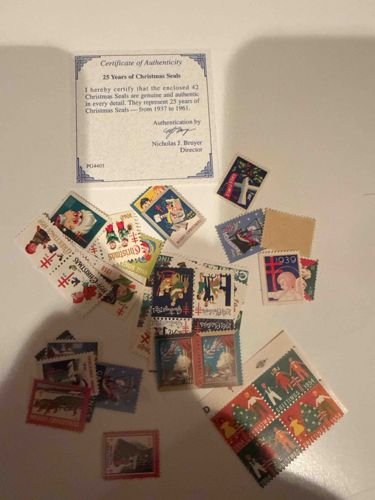
25 Years of Christmas Seals (1937–1961) Collection with Certificate of Authenticity

Philately / Cinderellas / Ephemera

AI Estimated Value

·Not an official valuation·Verify before acting

$45.00 - $75.00

As of June 15, 2026

AI Item Analysis

·AI can make mistakes·Verify before acting
This collection consists of 42 vintage Christmas Seals, also known as TB seals, spanning a twenty-five-year period from 1937 to 1961. The set is accompanied by a formal Certificate of Authenticity printed on white cardstock with a blue decorative border, signed by Director Nicholas J. Bruyer. The seals themselves display a variety of mid-century graphic design styles, featuring festive motifs such as Santa Claus, children, Christmas trees, and the iconic red double-barred cross associated with the American Lung Association (formerly National Tuberculosis Association). The seals vary in physical format, including single loose stamps, horizontal strips, and small blocks. They exhibit typical features of the period, such as perforated edges and gummed backs. One block specifically shows 'Greetings 1954' with a vibrant red and green illustration of children. The color palettes across the items are diverse, ranging from the muted tones of the late 1930s to the saturated lithographic colors of the late 50s. Condition appears to be generally Good to Very Good for ephemera of this age; while some items show slight curling and minor perforation wear typical of handled paper, there are no immediate signs of heavy staining or significant tears. The collection represents both a philanthropic history and a retrospective of mid-20th-century commercial illustration.

AI Appraisal Report

·AI can make mistakes·Verify before acting
I have examined the collection of 42 Christmas Seals spanning 1937–1961. Based on the visual evidence, the seals exhibit typical mid-century lithographic quality with period-appropriate saturation and typography. The presence of the certificate signed by Nicholas J. Bruyer suggests this was a retail set sold during the mid-to-late 20th century to collectors of philanthropic ephemera. The condition appears consistent with 'Very Good' philatelic standards; I note healthy perforations on the 1954 block and no significant foxing or adhesive migration, though minor curling is present. Market-wise, Christmas Seals are 'Cinderellas'—stamps not used for postage. Because they were printed in the millions to fund tuberculosis research, they are generally common. Value in this market is driven by completeness and the presence of original packaging or certificates, which this set possesses. Comparable sales of similar 25-year runs with COAs typically realize between $40 and $80 in estate auctions. While the visual details are consistent with authentic National Tuberculosis Association issues, a photograph cannot confirm the integrity of the gummed backing or detect microscopic 're-perfing.' A physical inspection would be required to verify the paper's fiber reacting to UV light and to confirm the ink chemistry. Furthermore, while the COA adds provenance, its own authenticity would need verification against known Bruyer signatures. The current valuation reflects the collection's appeal as a nostalgic historical record rather than a high-rarity philatelic investment.

Get your items appraised

Instant estimates of your treasures with AI-powered appraisals

Browse More Appraisals